Analyzing How Tumor Cells Interact in 3D Could Inform Future Cancer Treatment
October 1, 2025
By Gina Mantica
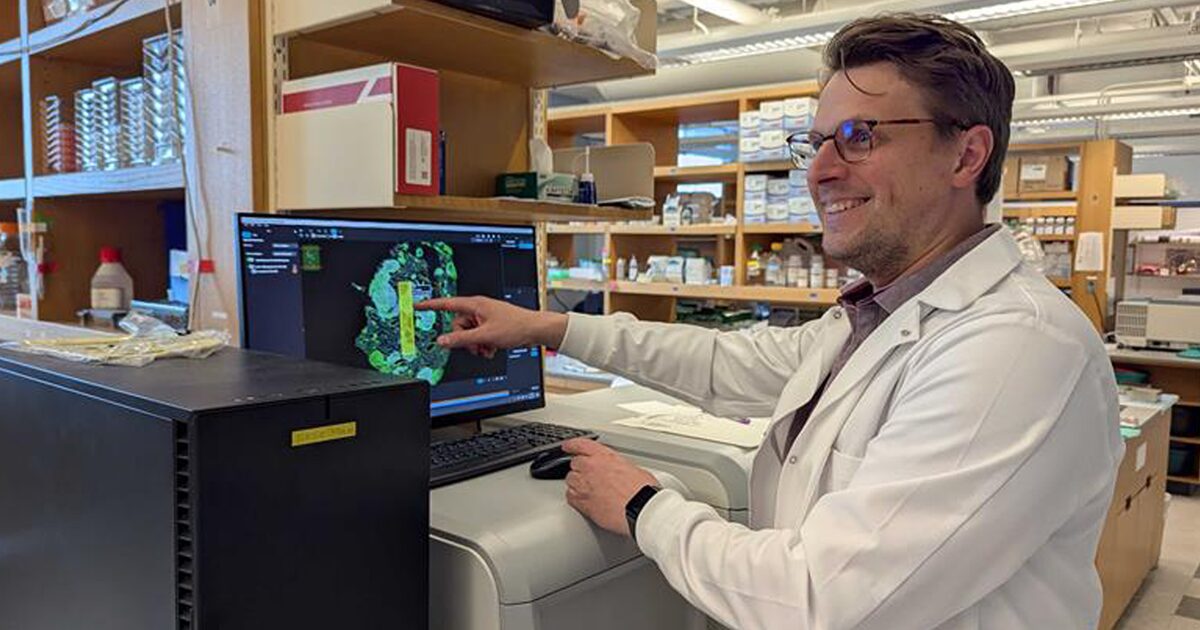
New BMC research helps us understand why certain treatments work for some people but not others—bringing us one step closer to personalized medicine.
In recent years, rapid advances in technology, big data, and artificial intelligence have transformed how we study biology—especially at the cellular level. Spatial biology is one of the exciting frontiers in this transformation. By combining the power of genomics with high-resolution imaging, spatial biology allows researchers to see not just what genes are active in a cell, but where that cell is located within a tissue and how it interacts with its neighbors. This spatial context is critical for understanding complex diseases and for tailoring treatments to individual patients.
Ruben Dries, PhD, Sections of Hematology & Medical Oncology and Computational Biomedicine and Associate Member of the Center for Regenerative Medicine (CReM), uses novel spatial technologies to analyze the landscapes of cancerous tumors, with the eventual goal to help clinicians determine the best course of treatment depending on the tumor’s composition.
HealthCity recently sat down with Dries to discuss how his lab is advancing the field of spatial biology.
HealthCity: What is spatial biology?
Ruben Dries, PhD: Spatial biology isn’t really anything new——however through recent technological advancements it can bring together two well-established fields: genomics and microscopy. What makes it exciting is that it allows us to look at tumor biopsies at incredibly high resolution, almost like zooming into a Google Map. For every single cell, we can see not only where it is located in the tissue, but also which genes are active inside it. This gives us a full, detailed picture of what’s happening in a tumor, cell by cell. Since every patient and every cancer is unique, this kind of insight helps us understand why certain treatments work for some people but not others—and brings us closer to truly personalized medicine.
HC: What inspired you to pursue research in spatial biology?
RD: I got into spatial biology by sheer luck—through a series of opportunities I never expected. As a first-generation college student, there is no one else in my family with any higher education degree. I didn’t even know what a PhD was when I started out, let alone imagine myself becoming a professor or leading a lab. But I knew that discovering new things brings me joy.
I studied stem cell biology for my bachelor’s and master’s degrees in Belgium. During that time, I began collaborating with Tsinghua University in Beijing, where I worked on developmental biology projects in zebrafish. This experience led me to systems biology, which looks at how different parts of a biological system—like genes, proteins, and cells—interact with each other to drive complex behaviors.
My interest in systems biology grew into a passion for bioinformatics—using computational tools to make sense of big, complicated biological data, like analyzing DNA sequences to understand gene activity and mutations. I got the opportunity to pursue this passion through a postdoc in the U.S. focused on computational biology, where I developed new methods for genomic data.
What draws me to spatial biology, in particular, is the joy of discovery—combining cutting-edge technologies to gain deeper insights into how cells behave in their natural environment and ultimately using that knowledge to help personalize medicine.
HC: What is the goal of your spatial biology research?
RD: In my research, I focus on understanding how cells are organized within tissues and how they work together to carry out complex biological functions. By creating detailed spatial maps of individual cells—capturing information at multiple levels such as genes, proteins, and metabolites—we can begin to see how cells coordinate with one another to form functioning tissues, both in health and disease. It’s like moving from a flat snapshot to a 3D view of biology in its natural environment. This spatial context is essential, because cells aren’t just isolated units—they need to be in the right place and properly connected to do their jobs. You can’t just mix random liver cells together and expect them to behave like a liver; their organization and communication matter deeply.
To support this kind of research, my lab developed the Giotto Suite, a powerful open-source software framework built in R, a statistical computing software, that allows researchers to represent, analyze, and visualize multiple types of spatial omics data. It’s an all-in-one solution that can take in raw data from various platforms, integrate different types of molecular information, and perform comprehensive spatial analyses—even in 3D.
The name “Giotto Suite” was inspired by Giotto di Bondone, a Late Middle Ages Italian painter who was one of the first to create art with a sense of depth and three-dimensionality—mirroring our goal of bringing tissue biology into a more complete, spatial perspective. The latest version of Giotto expands its capabilities to handle multimodal data, such as combining transcriptomics with proteomics, and includes tools for downstream analysis like identifying cellular niches—areas where groups of cells interact to drive tissue behavior. Researchers around the world are now using Giotto on both patient samples and animal models, and we hope this open-source tool continues to grow with contributions from the community to push the field of spatial biology forward. We published the details recently in Nature Methods.
HC: How does your spatial biology research impact patients?
RD: In the near term, our research brings us closer to truly personalized medicine—we aim to analyze a patient’s tumor in detail to identify its composition and determine the most effective treatment targets. We’re already piloting this approach by working with breast cancer core needle biopsies, using spatial profiling to better understand the tumor landscape. Looking ahead, this technology could also help predict a patient’s prognosis and guide the best course of treatment. What’s especially exciting is that we can now generate and analyze this kind of data within just a week, making it fast enough to be clinically relevant.
About the Author
Gina Mantica
Gina Mantica is the Senior Research Communications Manager at BMC.
Share on Social

Health equity news from Boston Medical Center
HealthCity is dedicated to sharing the most cutting-edge ideas for advancing health justice through inspiring stories, in-depth Q&As with equity pioneers, research news that could change the medical landscape, and more.