BMC-Takeda Collaboration Charts a Practical Course for Reducing Medical Waste Emissions
April 22, 2026
By Nina Ng
Jodi Hilton
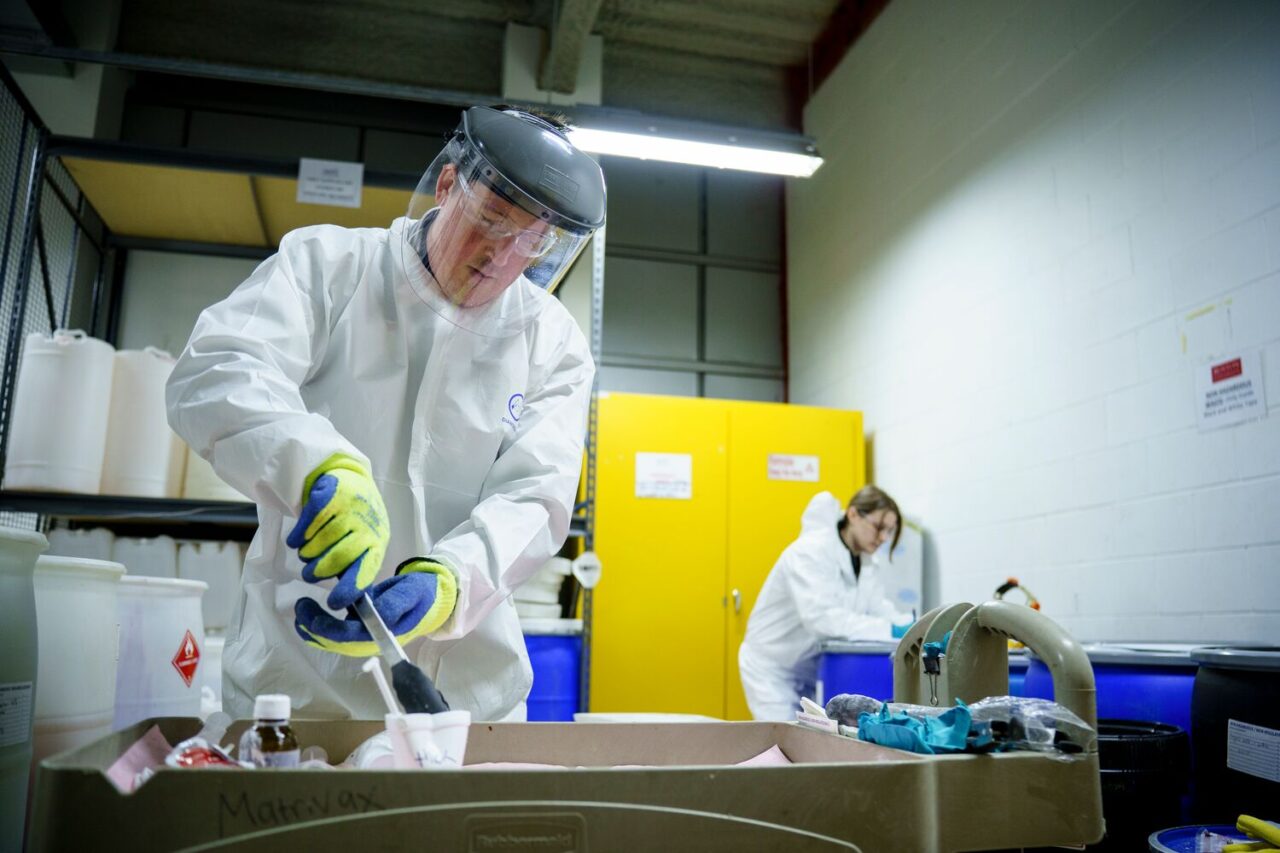
A Takeda worker poses for a photo illustrating medical waste disposal (March 3, 2026). Reducing waste and supply chain emissions helps to reduce healthcare’s climate footprint and support patient health.
In a new audit report, Boston Medical Center and Takeda uncovered data in a waste audit that helps other hospitals and health systems chart a path forward to reduce their footprint.
In 2025, Boston Medical Center (BMC) launched an innovative collaboration with biopharmaceutical company Takeda to reduce medical waste and supply chain emissions, an often-overlooked contributor to healthcare’s climate footprint.
The collaboration is set for three years with defined goals. Year one was focused on waste auditing, and the milestone one report from BMC and Takeda shows that approximately 75% to 85% of waste audited was misclassified, resulting in higher emissions and costs. Improved sorting, according to the results, could reduce related emissions by up to 70%. Year two progresses to develop solutions based on these findings and address hot spots to reduce emissions from medical waste.
HealthCity spoke with Anna Goldman, MD, MPH, MPA, primary care physician and medical director of sustainability at BMC, and Johanna Jobin, Global Head of Environmental Sustainability & Compliance at Takeda, about the recent year-one report and how this work connects to environmental health, patient health, and long-term goals.
HealthCity: BMC serves many patients from environmental justice communities. How do waste reduction and decarbonization efforts support community health?
Anna Goldman: I think about the impact in three main ways. First, according to the World Health Organization, climate change itself is one of the most serious threats to health globally, but it’s especially harmful for the communities BMC serves. Many of our patients live in frontline neighborhoods that experience more extreme heat and higher levels of air pollution. By reducing greenhouse gas emissions, we’re addressing an environmental driver of health outcomes.
Second, the waste we generate contributes to pollution. Healthcare produces a significant amount of waste—particularly, plastics, many of which breaks down into microplastics. There’s a growing body of evidence showing these are harmful to human health. So, reducing waste, especially plastic waste, is directly aligned with our goals to provide expert and equitable care to the communities we serve.
Third, waste has a financial cost. Certain waste streams, such as regulated medical waste, are much more expensive to dispose of than regular trash. Regulated medical waste is the portion of healthcare waste that may be contaminated with blood, body fluids, or other infectious materials, including sharps and lab cultures, among other things. It requires specialized handling, treatment, and disposal to minimize infection risks. When we reduce waste and sort it correctly, we save money that can ultimately be reinvested in patient care.
Johanna Jobin: The environment is a critical social determinant of health, and as a company focused on supporting better health, environmental sustainability is a key consideration across our business. This includes how we approach decisions across the value chain, from how products are designed and packaged, to how materials are sourced and ultimately disposed of. Through efforts like our collaboration with BMC, or engaging with our suppliers to advance more sustainable procurement practices, we believe that waste reduction and decarbonization initiatives can help advance health equity while simultaneously reducing environmental impacts.

HC: How does climate change show up in the daily lives and health outcomes of patients?
AG: Many of the communities we serve—like Dorchester, Roxbury, Mattapan, and Chelsea—are environmental justice communities. They’re often urban heat islands, with more asphalt and concrete, less tree cover, and higher air pollution.
These neighborhoods can be six to 10 degrees hotter than areas with more green space, which makes heat waves and rising summer temperatures especially dangerous. Many residents also face economic barriers that make it harder to afford air conditioning or higher electricity bills. So, when we talk about addressing climate change through supply chain emissions, it’s not abstract; it’s directly relevant to our patients’ lived experiences.
HC: Why did BMC decide to start this work with pharmaceutical waste specifically?
AG: The key reason is the collaboration itself. Addressing supply chain, or “Scope 3,” emissions requires strong cross-sector partnerships. These emissions come from the products we buy and use, and they account for about 80% of healthcare’s total carbon footprint.
“[W]hen we talk about addressing climate change through supply chain emissions, it’s not abstract; it’s directly relevant to our patients’ lived experiences.”
ANNA GOLDMAN, MEDICAL DIRECTOR OF SUSTAINABILITY AT BOSTON MEDICAL CENTER
Takeda is an upstream supplier for BMC, so our emissions are closely linked. We affect their downstream emissions, and they affect our upstream emissions. Because Takeda was willing to engage in an innovative collaboration, it was a natural next step to focus on areas where our emissions overlap most clearly: our pharmacy environments and infusion centers, where we administer intravenous medications (many of which they help produce).
This is one of our most exciting collaborations to date because it directly tackles one of the hardest parts of healthcare decarbonization.
HC: Many prescription bottles and packaging are discarded at home. How are you working to reduce environmental health risks beyond the hospital walls?
JJ: Takeda aims to incorporate sustainability principles across each phase of product development, from design through disposal at end-of-life. We encourage recycling and support initiatives, including drug take-back programs to help patients responsibly dispose of unused or expired medication and packaging.
There are also opportunities to reduce material use in the supply chain. We produce 500 million units of medicine each year. We set a goal to sustainably source 50% of our paper packaging by FY2025 and exceeded it by reaching 62% in FY2024, one year ahead of schedule.
Now, we aim to source 95% of our paper and paperboard from sustainable or recycled sources by FY2030. In some markets where regulations allow it, Takeda is also transitioning to e-leaflets to replace the paper inserts included with our medicines, decreasing environmental impacts while aiming to enhance patient experience
There is more work to do, and together we can enhance circularity across our product portfolio and greater environmental sustainability across the healthcare ecosystem.
HC: How could this collaboration influence other health systems, particularly essential hospitals?
AG: One of our biggest goals is scalability. The impact at BMC matters, but the real potential of this collaboration comes from sharing what we’ve learned so that others can replicate and iterate upon it. As we identify feasible solutions, we hope to co-develop them with partners and ultimately release a set of recommended interventions that other hospitals can adopt to reduce pharmacy-related emissions.
JJ: Knowledge-sharing is vital to that effort. We were pleased to work closely with BMC in creating the milestone one report, “Addressing Waste-Related Emissions in Healthcare,” accompanied by a “how-to” guide outlining what worked. It is the result of a one-year audit, and the learnings will be shared with other institutions who can apply our insights to their own unique contexts. Looking ahead, we are focused on sharing our findings broadly through publications, conference engagement, and ongoing dialogue with healthcare leaders, policymakers, and other key stakeholders.
HC: How do you measure success for a collaboration like this?
JJ: Emissions reductions and diverted waste are important indicators of progress toward broader goals. At Takeda, we aim to reduce greenhouse gas emissions and achieve net-zero across our value chain by 2040, part of our efforts to address the link between climate and health. This collaboration will support that aim and help others to follow.
“One of our core goals with BMC is to develop practical, scalable solutions that can be applied across diverse healthcare settings, including essential health system environments.”
Johanna Jobin, Global Head of Environmental Sustainability & Compliance at Takeda
AG: We also pay attention to the quality and durability of interventions. For example, finding new recycling pathways for pharmaceutical and IV-related waste is challenging, and in some cases, unprecedented. Success means building systems that didn’t really exist before—and that others can use after us.
HC: As the collaboration moves from insights to action, what’s the long-term vision for supporting broader adoption of waste and emissions reduction strategies across clinical operations and supply chain decisions?
JJ: One of our core goals with BMC is to develop practical, scalable solutions that can be applied across diverse healthcare settings, including essential health system environments. For example, health systems may be able to generate meaningful cost-savings from potentially straightforward changes to waste sorting. Waste also can be a pain-point for healthcare practitioners. We tremendously respect and appreciate their work and aim to develop approaches that could help address these issues.
AG: There’s an irony in providing care while simultaneously harming the environment that supports the health of our patients and communities. We want patients to know that we see that tension and that we’re taking meaningful steps. Over the next two years, as the next phase of our collaboration, BMC and Takeda will design and pilot programs that translate the insights from the year-one audit into practical, actionable solutions.
This Q&A has been condensed and edited for length and clarity.
About the Author

Nina Ng
Nina Ng is the Communications Manager at BMC.
Share on Social

Health equity news from Boston Medical Center
HealthCity is dedicated to sharing the most cutting-edge ideas for advancing health justice through inspiring stories, in-depth Q&As with equity pioneers, research news that could change the medical landscape, and more.