A Coalition of Color Is Transforming Health Equity in Massachusetts
June 19, 2026
Lindsey Tucker
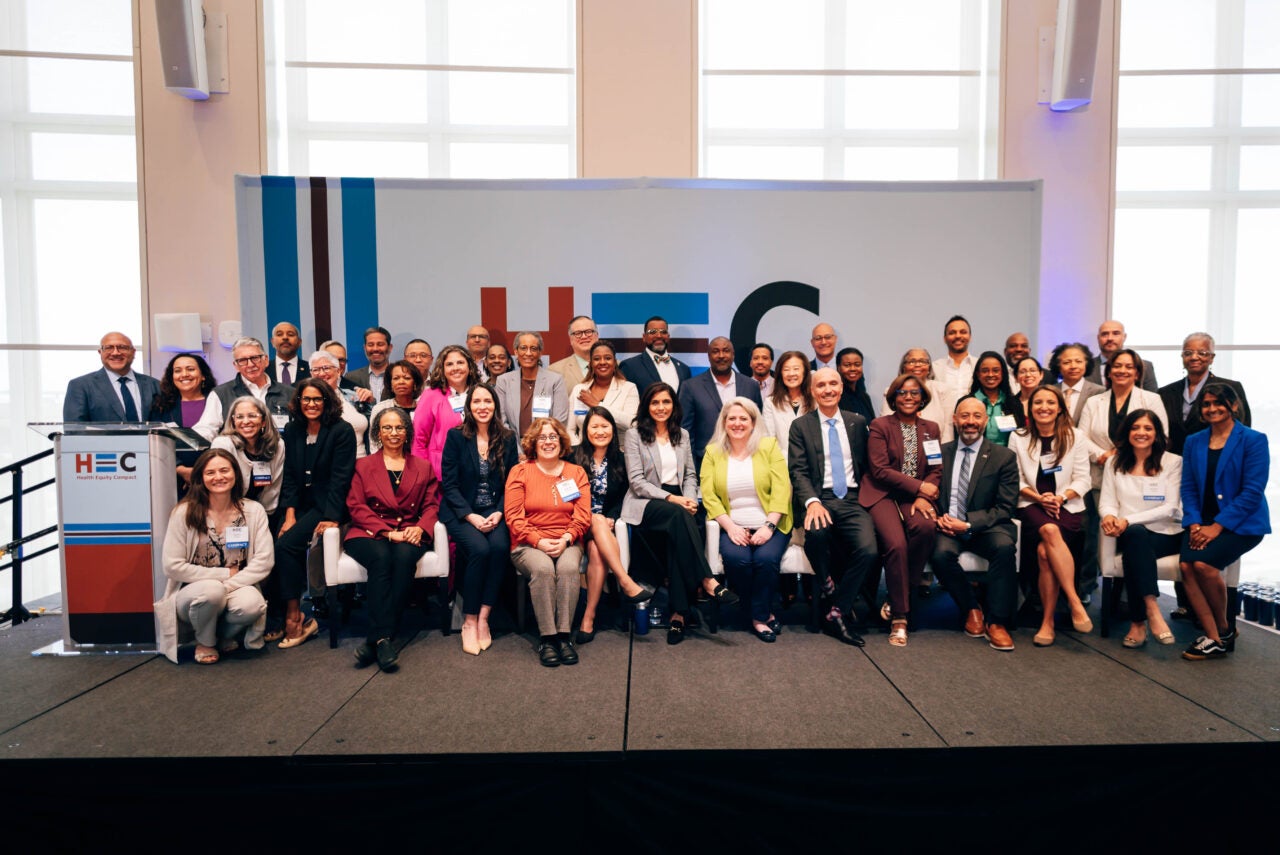
Compact members gather together with Amy Rosenthal, undersecretary for the Health for the Massachusetts Executive Office of Health and Human Services (EOHHS) at the 2026 Health Equity Trends Summit. The Health Equity Trends Summit convenes leaders from government, health care, business, and community organizations across Massachusetts. Tuesday, June 2.
When the Health Equity Compact launched in 2022, its founders recognized that systems change requires lived experience and professional expertise in the same room. Three years later, the 100-member group is closer than ever to turning that vision into policy—and it's not slowing down.
A recent report by the Boston Public Health Commission spells out in stark terms the state of Black life expectancy in Boston, a city where health disparities persist despite its rich array of health care resources. Not only do Black Bostonians die younger than every other racial and ethnic group in the city, the life expectancy gap has doubled over the past 10 years. Many of the premature deaths are driven by accidental drug overdoses and chronic conditions such as heart disease and diabetes.
Closing the racial gap in life expectancy, the report notes, will require equity-centered interventions that address health conditions along with factors that influence health, such as stable housing, economic security, and access to quality care.
Dr. Thea James, MD, MBA has had a close-up view of the factors that affect patients during her decades as an emergency room physician at Boston Medical Center (BMC), where she is vice president of mission, associate chief medical officer, and executive director of the essential hospital’s Health Equity Accelerator, which works to advance health equity and economic mobility in local communities.
“Patients come to us carrying not only illness, but the accumulated effects of economic instability, housing insecurity, and limited access to opportunity,” James wrote in a recent op-ed piece responding to the new report. “By the time many people reach the hospital, the upstream factors shaping their health have been at work for years.”
The Health Equity Compact is founded to drive state-wide change
In addition to her equity-advancing work at BMC, James is a founding member of the Health Equity Compact, a cross-sector group of 100 Massachusetts leaders of color launched in 2022 with a mission to transform the state’s institutions and public policies to ensure health equity. Compact members include leaders and experts of color in hospitals and community health centers, higher education, health and life sciences industries, philanthropic foundations, and public health institutions.
The Compact grew out of conversations starting in summer 2020, when the police killing of George Floyd sparked a national reckoning with longstanding racial injustices and the COVID-19 pandemic had cast a harsh spotlight on racial health disparities.
“There was a recognition that the window of opportunity for systems change around health equity would not stay open indefinitely, and that there was incredible power and possibility in leaders of color coming together with their lived experience and their professional expertise to drive change,” says Lindsey Tucker, the Compact’s managing director.
The Health Equity Compact expands reach, drives policy action
The group began as a loose coalition of 37 people. Today it has grown to 100 members and incorporated as a 501(c)(3) nonprofit with a small staff. The Compact’s work has been largely funded by its members and by foundation grants.
Soon after its launch, the Compact convened a series of community forums in New Bedford, Lawrence, Lowell, and Worcester to raise awareness of the Compact and to hear from community members about their policy priorities. What they learned in the forums helped shape the group’s legislative agenda, Tucker says.
A 2023 report by the Compact and the Blue Cross Blue Shield of Massachusetts Foundation examined the financial toll of the state’s racial and ethnic health disparities. The report calculated a loss of $5.9 billion each year in avoidable healthcare spending, lost labor productivity, and premature deaths.
“And that $5.9 billion in loss will double by 2050 if we don’t do anything about it,” Tucker says. “So, when we think about why this is important, it really matters to all communities, including business leaders for whom the strength of our Massachusetts economy is so important.”
The economic findings spurred closer connections with business leaders, some of whom have joined the Compact’s network of corporate allies.
The report was released at the Compact’s first Health Equity Trends Summit, bringing a cross-section of health policy stakeholders and elected officials together to discuss how to address racism and systemic barriers and advance equity. This annual convening has grown from 700 attendees in 2023 to more than 2,000 last year, Tucker says.
One of the main priorities of the Health Equity Compact has been drafting and advocating for an omnibus bill called An Act to Advance Health Equity that aims to improve access to quality care, ensure strategic investment in underserved communities, and build a representative healthcare workforce. First filed in 2023, the bill is now moving through its second legislative session.
Meanwhile, Tucker says, some other equity priorities the Compact worked on have already been enacted.
One of these is the 2025 Physicians Pathway Act that allows doctors whose training was in other countries to have a pathway toward medical licensure here.

In the affordability realm, another success was a measure making prescription drugs for diabetes, asthma, and heart conditions—chronic conditions more common in communities of color and low-income communities—far more affordable, which was part of the PACT Act, a pharmaceutical bill enacted in early 2025.
And another win, a step toward diversifying representation at policymaking tables, Tucker says, was the addition last year of a seat on the Center for Health Information and Analysis (CHIA) oversight council that’s reserved for someone with health equity advocacy experience. The new seat is currently held by Compact member Amie Shei, PhD president and ceo of The Health Foundation of Central Massachusetts.
Lived experience drives the Health Equity Compact’s urgency and action
A 2024 case study of the Compact by the national Delta Center for a Thriving Safety Net emphasized the value of tapping leaders with lived experience to tackle the issues that have affected them and their communities.
“For Compact members, health disparities and inequities are not abstract ideas or statistics; the moral imperative of health equity is deeply personal,” the report says. “Lived experience is a driving force of the Compact and why members continue to join and invest in this collective, anti-racist work.”
“For Compact members, health disparities and inequities are not abstract ideas or statistics; the moral imperative of health equity is deeply personal.”
Delta Center for a Thriving Safety Net, “Massachusetts Health Equity Compact: A Model for Systems Change to Advance Health Equity” 2024 Case Study, p. 18
Compact co-founder Michael Curry, president and ceo of the Massachusetts League of Community Health Centers, underscored this last year at a rally in support of An Act to Advance Health Equity.
“For the folks in my family who are dying [disproportionately] of diabetes and heart disease and cancer, I have an imperative to show up in this building and be part of this movement,” Curry said. “This is not just about policy for policy’s sake. This is about demanding, urging legislators, to address the inequities I grew up in and see when I go home.”
The Health Equity Compact builds toward long-term reform to address life expectancy inequities
The Compact’s near-term goals include sustaining momentum for An Act to Advance Health Equity and focusing on two specific issues: primary care reform and access to care for MA residents who are losing coverage, in particular immigrant communities.
As federal policy actions slash access to health coverage, research funding, and even data on health disparities, the Compact’s 2026 Health Equity Trends Summit, hosted on June 2, aimed to respond to the current moment, Tucker says, with sessions on ensuring access to care for immigrant communities, investing in community health workers, and building a more equitable primary care system.
“Our long-term vision is transformational change,” Tucker says, “so that Massachusetts is a place where everyone has the same opportunities to live a long and healthy life, regardless of race or zip code.”
Lindsey Tucker, Managing Director, Health Equity Compact
The Compact also is working to nurture the network and pipeline of leaders of color, working to support and build connections and capacity for its members and for the future leaders they may be mentoring and coaching, Tucker says.
As for the longer term, the group is keeping an eye on its core reason for being.
“Our long-term vision is transformational change,” Tucker says, “so that Massachusetts is a place where everyone has the same opportunities to live a long and healthy life, regardless of race or zip code.”
About the Author

Sandra Larson
Sandra Larson is a Boston-based freelance journalist covering urban and social issues and policy. Besides HealthCity, her work has appeared in Bay State Banner, Next City, The New York Times, and The Guardian. She holds a master’s degree in Urban and Regional Policy from Northeastern University.
Share on Social

Health equity news from Boston Medical Center
HealthCity is dedicated to sharing the most cutting-edge ideas for advancing health justice through inspiring stories, in-depth Q&As with equity pioneers, research news that could change the medical landscape, and more.