Boston Medical Center
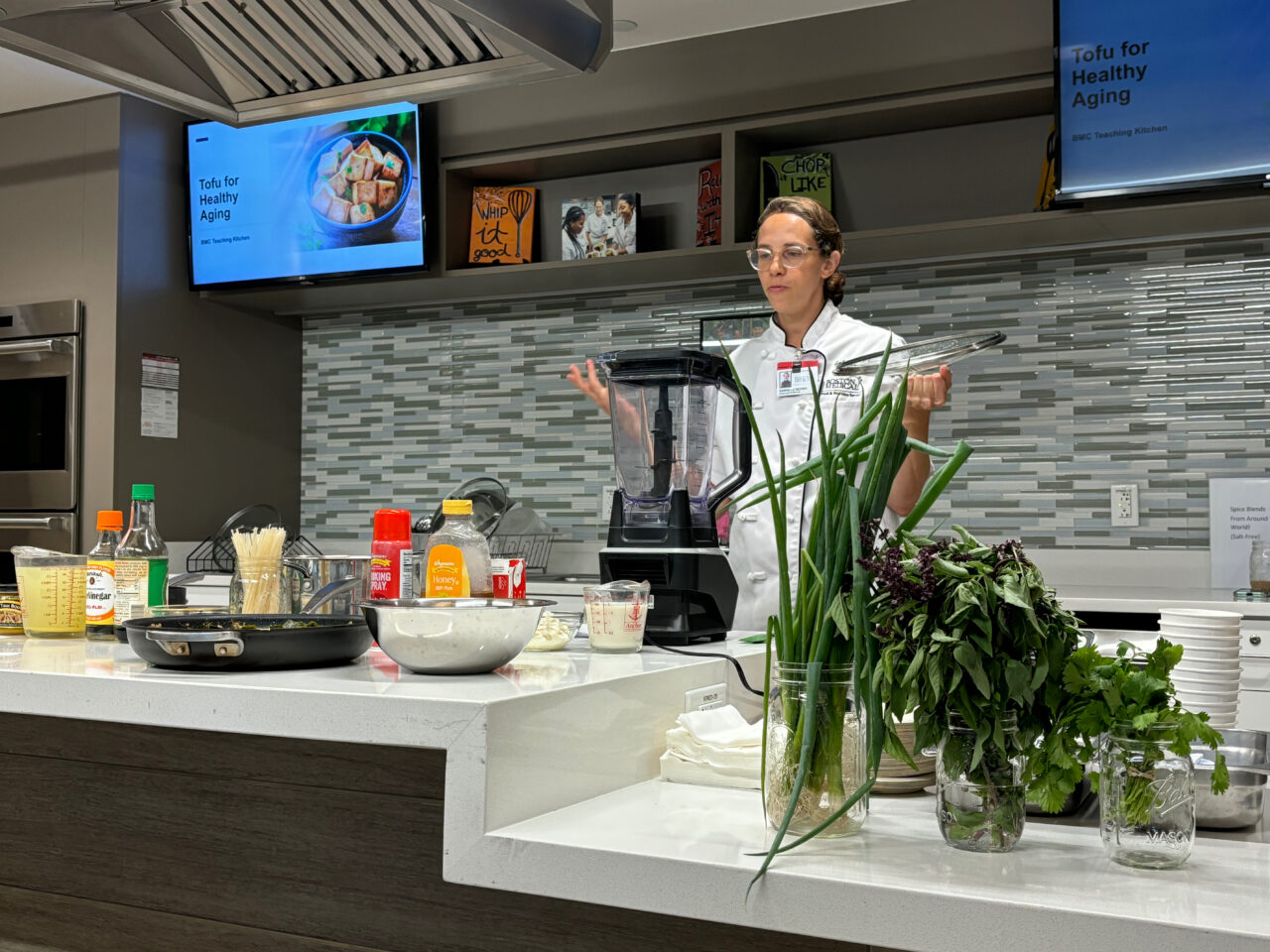
Gabrielle Simmons teaches the Tofu for Healthy Aging class for BMC's Geriatrics Department at the hospital's Teaching Kitchen.
This three-part series, offered by BMC's Teaching Kitchen, teaches patients aged 70 and older about the health benefits of tofu and how to prepare it.
At 88 years old, Marjorie Tyril is accustomed to hospital visits. The Jamaica Plain resident is a patient at Boston Medical Center’s Geriatrics Ambulatory Practice, where she receives both her primary and specialty care. But today’s hospital visit is remarkably different. In place of a white doctor’s coat, the woman at the front of the room dons a white chef’s coat. Discussing the dietary benefits of berries, she holds up a bowl of colorful frozen fruit, dispensing it into a blender along with honey, cinnamon, and then, surprisingly, a package of silken tofu. Marjorie nods appreciatively with the other patients and caregivers in the room, as the blender whirs the ingredients into a creamy, protein-packed smoothie.
Marjorie is participating in a culinary medicine class called Tofu for Healthy Aging. Funded through a one-year Boston Medical Center (BMC) Patient Safety Grant, the program introduces patients 70 and older to the often-overlooked superfood. Packed with protein and essential minerals like calcium and manganese, tofu is soft, easy to eat, and adaptable to a variety of cuisines. It can be a perfect addition to the diets of older adults, who require higher levels of protein to maintain their muscle mass as they age.
“I find a lot of my patients would tell me that they don’t eat as much meat as they used to eat, for a lot of reasons: their teeth, taste changes, and costs,” explains Won Lee, MD, geriatrician and director of the Home Care Program for BMC’s Geriatrics Department. “Being able to open people’s horizons to new foods that can impact their health is a lot of fun.”
Dr. Lee developed the three-part series along with Geriatrics fellow Shreya Bhatia, MD, and BMC Teaching Kitchen Manager Gabrielle Simons, MS, RD, LDN. Based in the BMC Teaching Kitchen, the interactive program is one part shared medical appointment focusing on chronic disease management and one part cooking class. Dr. Lee meets privately with each patient to take their vitals, and listen to their concerns, and discuss their medical status like any standard check-up. Meanwhile, Simons leads a series of cooking demonstrations, engaging participants on nutrition fundamentals that can inform their dietary decisions. Marjorie’s daughter and primary caregiver, Linda Stanford, also attended the program and was surprised at how much she learned.
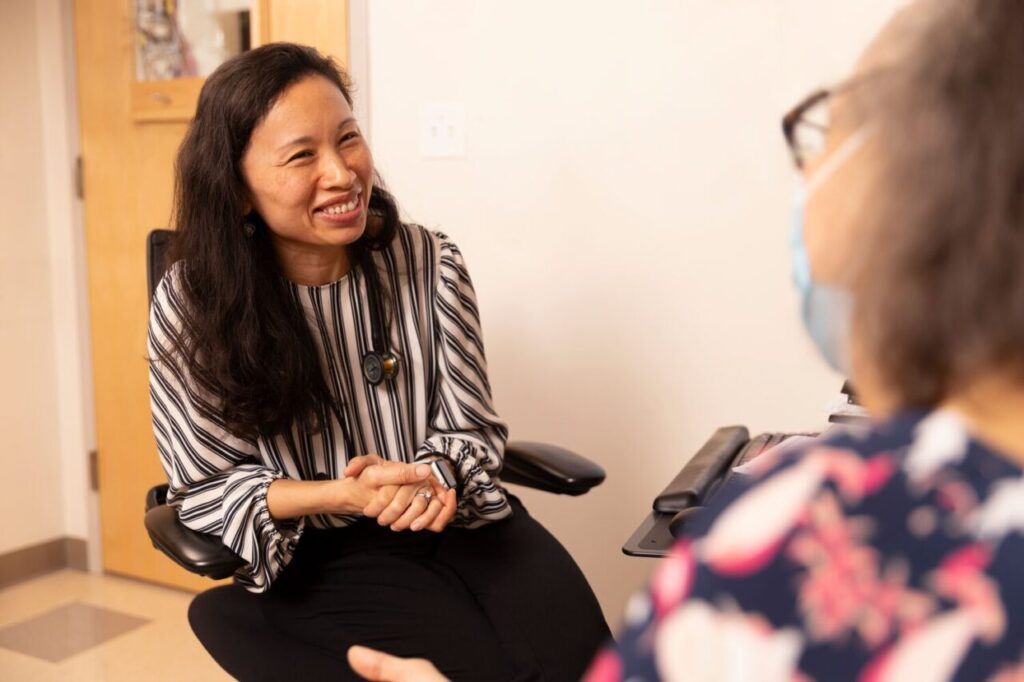
“It’s an eye-opener for anyone who’s a caregiver. We’re from Barbados so some of the traditional foods that we cook you discover they are heavy on the starches, the carbs, and even the meat,” she said. “They go ingredient by ingredient, teaching you how to read the label and serving size. It wasn’t only helpful for mom, it was helpful for me.”
Culinary medicine that nurtures community
While a healthy diet is a critical component to combat chronic diseases such as hypertension, diabetes, and osteoporosis, Drs. Lee and Bhatia also designed the classes to address another epidemic plaguing older adults: loneliness. Mounting evidence suggests that social isolation and loneliness negatively impact mental and physical health, contributing to or worsening conditions such as depression, anxiety, cognitive decline, and heart disease. A portion of the grant covered transportation for participants to ensure they could attend the monthly sessions. Classes intentionally included partner work and group activities to further encourage interaction. Marjorie appreciated the social aspect of the classes and the group tasting at the end, which sparked casual conversation.
“I enjoyed it. Everybody had different ailments, and we would talk during the meetings and after the meetings, and I would learn about them, and they would learn about me. [As for the tofu,] that’s the first time I tried it. I heard about it, but that’s the first time I ate it, too. We got seconds,” she chuckled.
Dr. Lee also underlined the eagerness of patients to connect. “I had one gentleman who turned out to be allergic to soy. He said he just thought this class would be fun,” she recalls. “I think that really speaks to the socialization piece and thinking of things that we as a health system can do to support our patients with socialization and combating loneliness, but in a medical and sustainable way.”
Encouraging exploration and adaptation
Tofu for Healthy Aging introduced three methods of tofu preparation that could be easily adapted to patient’s tastes and food traditions: a scramble, a smoothie, and a soup. Patients and caregivers left the class with the recipe and ingredients to recreate it at home. Linda has cooked the soup at home for her mother, adapting the recipe to add her family’s favorite spices and some chicken to the broth.
I had one gentleman who turned out to be allergic to soy. He said he just thought this class would be fun. I think that really speaks to the socialization piece and thinking of things that we as a health system can do to support our patients with socialization and combating loneliness, but in a medical and sustainable way.
dr. won lee
“I told Dr. Lee it is great to get all this firsthand knowledge. I’m not going to tell you I’m a lover of tofu,” Linda admits, “but I actually do enjoy it more now.”
Dr. Bhatia is working to follow up with participants of the pilot to investigate if the shared medical appointment model impacted their chronic disease management. For instance, did people screen positive for diabetes or depression during these appointments, or did the nutrition education influence the management of their disease? Did patients’ blood pressure or insulin sensitivity improve based on changes to their diet?
Next year, Dr. Lee hopes to expand the program’s focus to incorporate more foods and potentially bring the model out of the hospital and into senior centers and assisted living facilities in the community.
“We want to serve our geriatric population in a way that shows that we’re thinking about them, that we’re here for them, and we want to innovate for them,” she emphasizes.
About the Author
Meryl Bailey
Meryl is a freelance writer passionate about public health, social justice, and medical innovation. As part of her writing career, she worked as a communications specialist in both the healthcare and nonprofit sectors. She holds a bachelor's degree in English literature from Georgetown University.
Share on Social

Health equity news from Boston Medical Center
HealthCity is dedicated to sharing the most cutting-edge ideas for advancing health justice through inspiring stories, in-depth Q&As with equity pioneers, research news that could change the medical landscape, and more.