One NICU Doctor Is Finding the Cellular Clues to Preeclampsia’s Impact on Babies
September 25, 2025
By Gina Mantica
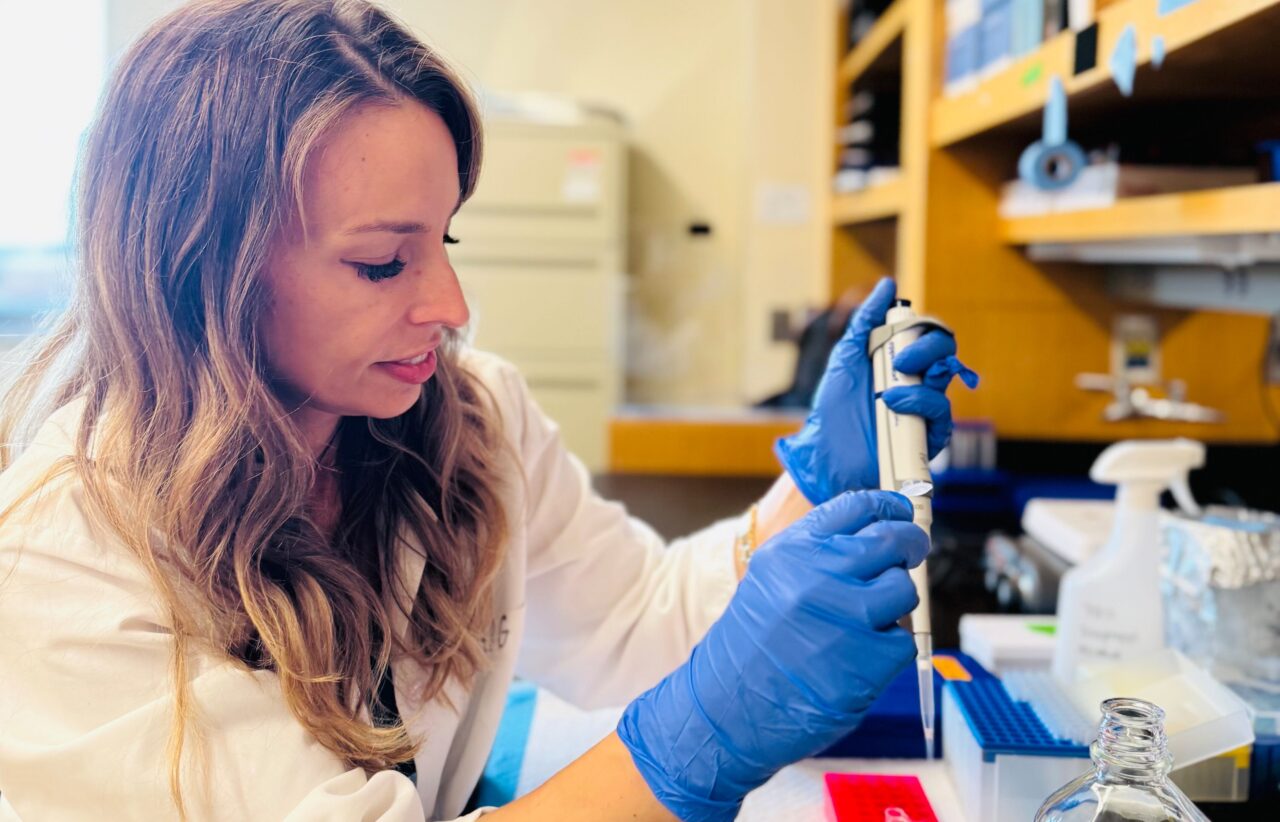
Dr. Elizabeth Taglauer
Elizabeth Taglauer works in her research lab at the Center for Regenerative Medicine.
Elizabeth Taglauer, MD, PhD, uses lung cells to study how the placenta can disrupt babies’ development in preeclampsia.
Preeclampsia is a pregnancy complication that affects about 2 to 8% of pregnancies worldwide, according to the World Health Organization. It happens when there is an abnormal interaction between the placenta and the mother’s blood vessels, leading to high blood pressure and in some cases, seizures and even liver and kidney problems. Preeclampsia disproportionately affects Black women in the U.S., with a 60% higher risk than for white women. Despite how common and serious preeclampsia is, there’s been comparatively fewer biomedical research studies focused specifically on Black patients and other patients of color—and even fewer studies on how preeclampsia affects their babies.
Elizabeth Taglauer, MD, PhD, a neonatal intensive care physician at Boston Medical Center (BMC) and an assistant professor at Boston University Chobanian & Avedisian School of Medicine, aims to improve health outcomes for babies whose mothers have preeclampsia during pregnancy. Preeclampsia can lead to premature birth and growth restriction, as well as increased risk of infant lung and gut diseases.
HealthCity recently sat down with Taglauer to discuss how her lab is turning to cellular biology to better understand how preeclampsia impacts babies’ development.
HealthCity: What inspired you to pursue placental biology research?
Elizabeth Taglauer, MD, PhD: I was passionate about science long before I ever considered medicine. In high school, my AP biology teacher introduced us to cell biology and genetics, and I was on fire. I remember bringing my textbook home to show my parents because I just loved the information I was learning. At that point, I didn’t think I wanted to go to medical school because I wanted to get to an active scientific career as quickly as possible. My teacher suggested I look into genetic counseling, so I went to college with that in mind and really got into the field.
The summer of my junior year, I did an internship in breast cancer research at the Lawrence Berkeley National Laboratory in California as part of a summer undergraduate program. That experience shifted something in me. I realized I wanted to apply science in ways that directly help people. After college, I was awarded a Fulbright Fellowship and spent time at the Marie Curie Institute in Paris, which confirmed that I wanted to pursue both medicine and research. At that time, I applied to MD/PhD programs.
I ended up in at the University of Kansas School of Medicine, which, interestingly, has a strong research community focused on the placenta. During my PhD thesis, I worked with an amazing mentor whose work on placental biology sparked my interest in neonatology. I eventually I realized I could combine placental biology and neonatal care into what is now my dream job.
“At BMC, I collect samples from placental tissues to study ways to improve the health of infants I treat in the BMC NICU. It’s a powerful full-circle experience. My research is shaped not just by fascinating scientific questions, but by the patients themselves.”
DR. ELIZABETH TAGLAUER, Neonatal Intensive Care Physician AT bmc
At BMC, I collect samples from placental tissues to study ways to improve the health of infants I treat in the BMC NICU. It’s a powerful full-circle experience. My research is shaped not just by fascinating scientific questions, but by the patients themselves. The high-risk, diverse population of pregnant patients and babies at BMC are among the most understudied globally in women and infant health research. Their stories, and the social and biological factors driving their illnesses, are central to the questions I ask in my research and the answers I hope to find.
HC: What is the goal of your placental biology research?
ET: Clinically, we know that preeclampsia is resolved once the baby is delivered, but the story doesn’t end there. Premature babies born to mothers with preeclampsia are still at significantly higher risk for long-term health issues, including a chronic lung disease called bronchopulmonary dysplasia and a gut disease called necrotizing enterocolitis. What we don’t fully understand is why, and that’s the core of my research.
We take samples of placentas from preeclamptic pregnancies after delivery, which is a safe way to study our questions because placentas are routinely discarded. With these samples we look at how the placenta might be influencing fetal development, particularly the lungs and gut. The placenta plays a central role during pregnancy, sending out signals to both the mother and the fetus. In preeclampsia, those signals become dysregulated and have a big impact on the blood vessels in the mother’s body. My work focuses on this same phenomenon on the fetal side. I am studying how these abnormal placental signals affect the development of the baby’s lungs and gut before birth.
To tackle these questions, we are partnering with Dr. Darrell Kotton at the Center for Regenerative Medicine, a joint initiative of the BU Chobanian & Avedisian School of Medicine and BMC. In this partnership, we are using cutting-edge models with lung cells to examine how different signals from the placenta may be disrupting lung development in a way that increases a baby’s risk for chronic diseases. We’re starting with the lung but are hoping to also develop models with gut cells in the coming years.
Our goal is to develop safe and informative models of human development and use them to understand how proteins related to blood vessel development and inflammation that are released by a preeclamptic placenta may be causing injury to the development of babies’ lungs and gut. Ultimately, we hope this research leads to new strategies for protecting and improving lung and gut health in vulnerable infants, particularly during their early days in the NICU.
HC: How does your placental biology research impact patients?
ET: Preeclampsia is really scary because many mothers don’t have any symptoms. Often, it isn’t until they come into clinic and someone checks their blood pressure that the condition is detected. By that point, the placenta may have been affecting the baby’s development for weeks.
“Ultimately, we hope this research leads to new strategies for protecting and improving lung and gut health in vulnerable infants, particularly during their early days in the NICU.”
DR. ELIZABETH TAGLAUER, Neonatal Intensive Care Physician AT bmc
The impact on the baby can be significant. Babies with the lung disease of bronchopulmonary dysplasia often require prolonged breathing support such as ventilators and oxygen, which can affect brain development, feeding, and growth. In cases where babies develop the gut disease of necrotizing enterocolitis, babies require pauses in their feeding and in some severe cases they may need emergency surgery to help their intestines heal.
There is a lot of important work being done to help mothers with preeclampsia, but there is a larger gap when it comes to understanding how to care for the affected babies after birth. My research is focused on filling that gap. By understanding how placental dysfunction affects fetal development, we can begin to improve the care these infants receive in the NICU.
This research could lead to changes in how we manage these babies after birth. We may be able to use different types of breathing support, adjust how we feed them, or even develop safe therapies to help heal their lungs and gut.
Rather than trying to change what happens during pregnancy, which can be complex, my focus is on what we can do once the baby is born. The hope is to improve outcomes by supporting these vulnerable infants in ways that are directly informed by how they were affected in the womb.
This interview has been edited and condensed for clarity and length.
About the Author
Gina Mantica
Gina Mantica is the Senior Research Communications Manager at BMC.
Share on Social

Health equity news from Boston Medical Center
HealthCity is dedicated to sharing the most cutting-edge ideas for advancing health justice through inspiring stories, in-depth Q&As with equity pioneers, research news that could change the medical landscape, and more.