She Found Addiction Recovery Through Musical Theater—Now She's Helping Others Do the Same
September 11, 2025
Boston Medical Center
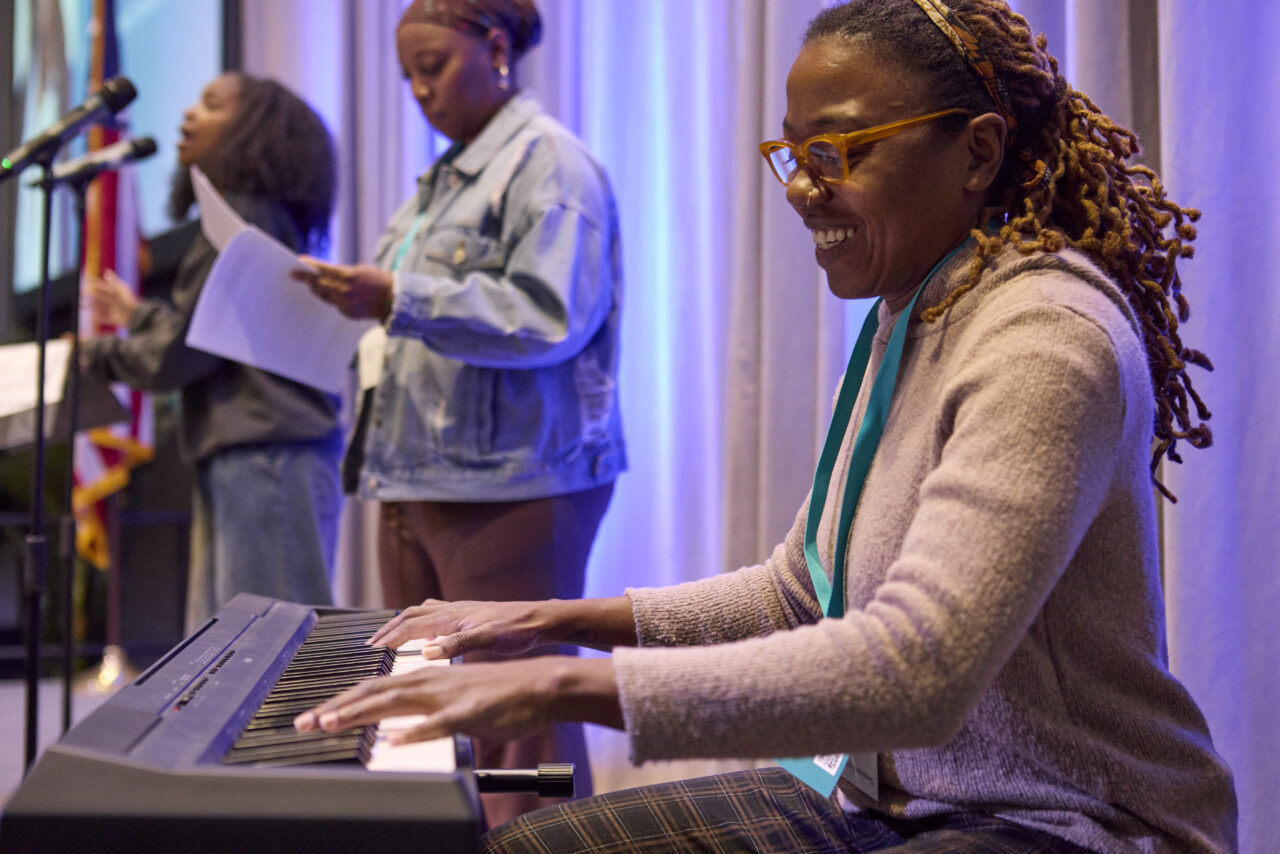
Elizabeth Addison performs pieces from her musicals at Together for Hope 2025, an annual conference on substance use disorder from Boston Medical Center's Grayken Center of Addiction.
Elizabeth Addison turned her year in a women's residential treatment facility into the inspiration for deeply personal musicals about substance use disorder, trauma, and recovery. Now, as a creative recovery coach, she uses narrative therapy to help others rewrite their own stories of healing.
Elizabeth Addison was one week into her year-long stay at a women’s residential treatment facility for substance use disorder when she had an epiphany: her surroundings had all the elements of compelling theater, including inherent conflict, drama, and what she recognized as a hero’s journey. That observation in her late twenties has since developed into a distinctive approach and career combining musical theater with narrative therapy to help people living with SUD and trauma.
Addison has written and staged four deeply personal musicals, two specifically about her treatment for SUD and her nearly decade of active addiction: This Is Treatment and Chasing Grace. Her work exists at the intersection of recovery and performing arts. But her professional work extends beyond the stage. After finding a pathway toward healing and recovery through the performing arts, Addison also works as a creative recovery coach with the Meghann Perry Group, facilitating storytelling workshops and helping others with the same techniques that have helped and guided her.
With an off-Broadway run set for Chasing Grace in March 2026, HealthCity spoke with Addison about her creative healing and recovery process, what made her decide to put her experiences with treatment on stage in musicals, and what she hopes for others living with addiction moving forward.
HealthCity: How did you decide to take your experiences, particularly your experience in addiction recovery, and put them on stage as musicals?
Elizabeth Addison: After seeing Rent for the first time when I was 13 at the Schubert Theater in Boston, I said that I would write a story about my family and our experience with my father, his addiction, and the toll that it had on our family. Already at that young age, I was identifying a form of narrative therapy, something that would heal me.
I went to treatment in my late 20s, and in my first week, I thought to myself, ‘Wow this is so dramatic. It could be a play.” There’s inherent conflict, drama—and it’s a hero’s journey. I decided to write a one-woman show where I would embody these seven different characters in treatment. But eventually I couldn’t ignore the call that this was a musical. I was going to figure it out. I wrote my first song, and from there it was over. I’ve been following or chasing grace ever since.
HC: Storytelling itself is a central theme in your work. How did the process of writing and staging your own story affect your own healing in recovery. Did it change your approach?
EA: If you looked at my first drafts of This Is Treatment, you would not like the main character, Grace—this is feedback I received from the audience. You’d be more interested in all the other characters because they were more three-dimensional, more rich, more interesting. Grace just seemed like a stuck-up bitch, really. And why was that? Because that’s how I saw myself.
I didn’t know how to three-dimensionalize Grace because of my own limitations within how I saw myself as well as within my own limitations in terms of my skill.
When the COVID pandemic shut down Broadway in 2020, seven years into writing This Is Treatment, I tasked myself with writing a whole new draft. I got rid of practically every song, and I started again.
One of the things I had to do was say, “I have to learn how to love you, Grace. How do I do that?” In my childhood, there was so much trauma, as a result of my father’s addiction and my mother’s unhealed trauma and mental health challenges—and not being able to talk about it. It was just very chaotic and very challenging.
Up until 2020, I couldn’t look back with any kindness. I couldn’t look back with any sort of empathy, compassion, or understanding. I had to dig into why I love musicals, why I’m doing this. What that looked like was a song called “Chasing Beads.”
I found an old thing that I loved as a child: lemon squares! We just to go to a bakery across the field and my favorite thing was how amazing the bakery smelled and the lemon squares. From looking at Grace through the lens of a child, I was able to unlock my love for her and, therefore, my love for myself.
Through this form of narrative therapy, I re-story these experiences for myself. The process of writing these musicals has been the biggest source of my healing. Every single musical gives me perspective that I never could have had if I weren’t looking at myself as a character and trying to unpack what happened to them.
HC: Can you talk about your work helping others find that same kind of feeling through narrative therapy and storytelling?
EA: As a recovery coach, I believe that people are the experts in their own lives and experiences, and I look through the lens of strength and resilience, not weakness or sickness. In narrative therapy, we talk about the fact that the stories we tell ourselves drive our experience but if we change the story, we can change how we experience life. Perception is everything. And once you realize that you have the ability to reauthor any one of your many stories, you can transform your life into one that is truly meaningful and in alignment with your gifts, skills, goals, values, etc.
HC: Has there been an audience reaction or feedback that has really stuck with you?
EA: Someone was wondering why I was choosing to tell a story about Black and Brown women that wasn’t of excellence. We still hold a lot of shame…. There’s still stigma, judgement, there’s still all sorts of things within a lot of Black and Brown communities around substance use challenges and the narratives the media sold us about it in the ‘80s and ‘90s. For me, we still need to work through it.
My job isn’t to tell the story of all Black and Brown women. I can’t even come close to doing that, and I don’t even want to. My job is to literally just tell a thoughtful, loving story about some really complex characters with really complicated experiences who happen to look like me. That’s it.
HC: What do you want people who haven’t had these kinds of experiences, whether it is in recovery or whether it is with substance use disorder, to take away from your shows?
EA: There’s something that we talk about in storytelling where the more specific you get, the more universal it becomes.
We’re all human. We all have been gifted a set of emotions, and my job is to make you feel something through the specificity of the story that I’m telling. If you feel moved, touched, inspired, feel some empathy, find some compassion for these characters, find some compassion for yourself, I’ve done my job.
Perhaps that feeling could encourage you to tell your story, or write your play, or talk to your family member—whatever that looks like for you.
HC: Moving forward, what is your ideal future for how we approach recovery and substance use disorder?
EA: I just want the tent of recovery to get bigger and bigger and bigger and bigger so that anybody who struggles with substance use disorder, mental health challenges, or trauma had the support and resources that they need to live the best life according to them.
I want us to remember what is our job and what isn’t our job. You are the expert in yourself and your experiences. I’m not here to heal you; that is your job. I’m here to help support you in being able to do that for yourself.
There’s a Maori elder who talked about “mauri,” which, in essence, is your life force. I think that for people who struggle with these challenges, their spirit hasn’t died, but it’s life force has diminished greatly. I look at my role as someone who breathes life into others and in doing that, supports that flame—their life force, to grow and grow and grow. And at some point, I step away because they can do that for themselves. And then I can watch from close up or afar as they find their way into becoming who they were always meant to be.
For more, follow Elizabeth Addison on TikTok @elizabethspeaks and follow Chasing Grace on Instagram @chasinggracemusical. Help bring Chasing Grace to life by learning more or donating on the SheNYC Arts website. All donations to this production are tax deductible.
This interview has been edited and condensed for length and clarity.
About the Author
Caitlin White
Caitlin White is the Senior Manager of Content Strategy at Boston Medical Center Health System.
Share on Social

Health equity news from Boston Medical Center
HealthCity is dedicated to sharing the most cutting-edge ideas for advancing health justice through inspiring stories, in-depth Q&As with equity pioneers, research news that could change the medical landscape, and more.