The Right Diagnosis Changes Everything for Kids With Fetal Alcohol Spectrum Disorders
April 2, 2026
By Gina Mantica
Jacqueline Savetsky German
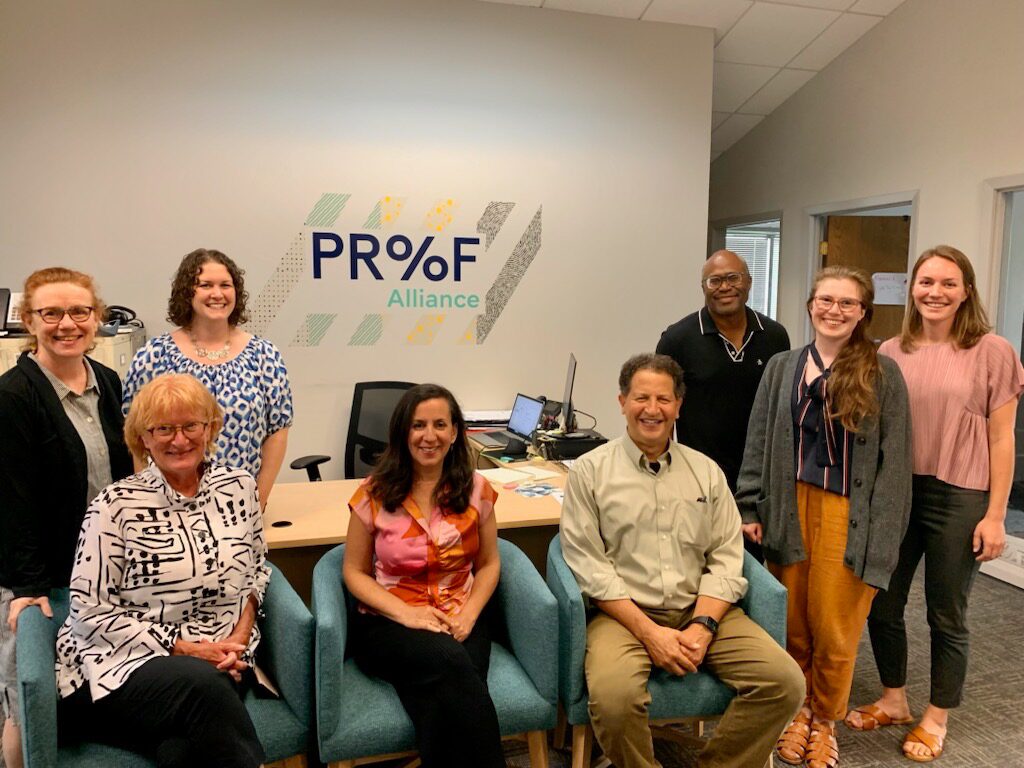
Individuals from a BMC research team, led by Daniel Alford, MD, MPH, director of the Clinical Addiction Research and Education (CARE) Unit, and Proof Alliance pose for a photo after a day of collaborative work to advance research on fetal alcohol spectrum disorders. (Clockwise from right): Kendra Gludt, MPH; Ilana Hardesty, MA; Sara Messelt; Vincent C. Smith, MD, MPH; Nicole Kitten, MPH; Amy Harlowe, MPhil; Alford, MD, MPH; Jacqueline Savetsky German, MPH
Virtual training helps clinicians recognize often-overlooked signs of fetal alcohol spectrum disorders, giving children and families earlier access to tailored care and support.
Fetal alcohol spectrum disorders (FASD) remain the most common, preventable causes of intellectual and developmental disabilities in the U.S. According to the Centers for Disease Control and Prevention, up to 5% of U.S. school-aged children may be affected by FASD, which comprises a spectrum of conditions caused by prenatal alcohol exposure that can lead to lifelong physical, cognitive, and neurobehavioral challenges. Yet for many children and families, the condition goes unrecognized for years, often surfacing only after behavioral or learning challenges emerge in school.
New research led by Daniel Alford, MD, MPH, Principal Investigator, SAFEST Choice National Learning Collaborative, and published in The Journal of Pediatrics: Clinical Practice, highlights a promising approach to closing that gap by training clinicians and their teams to better identify FASD and support affected families.
The study evaluates the SAFEST Choice Learning Collaborative, a virtual training program funded by the Health Resources and Services Administration (HRSA) and designed in partnership with Proof Alliance to help healthcare professionals screen for prenatal alcohol exposure, recognize the signs of FASD, and implement evidence-informed interventions. The program uses the Project ECHO (Extension for Community Healthcare Outcomes) virtual education model, combining expert lectures with real-world case discussions across the Northeast and Upper Midwest.
“Our findings show that clinicians are not only highly satisfied with the training, but that it meaningfully improves their confidence and their clinical practices,” says Dr. Alford, who is also a primary care physician at Boston Medical Center (BMC). “Participants reported increased self-efficacy in screening for prenatal alcohol exposure, recognizing FASD, and having conversations with families, along with changes to how they practice.”
Brain-based differences in fetal alcohol spectrum disorders
That increased confidence is especially important given how complex FASD can be to identify; there are no clear biomarkers, and symptoms can mimic those of other conditions.
“Children may be diagnosed with ADHD or autism, but there is something different about the wiring of the brains of youth with FASD that makes their symptoms less responsive to typical treatments,” says Marilyn Augustyn, MD, a developmental behavioral pediatrician at BMC. “Without understanding FASD as the underlying cause, we may miss opportunities to provide the right support.”
Part of that complexity stems from how alcohol affects the developing brain at different stages of pregnancy. During the first trimester, when the brain and nervous system are forming, alcohol exposure can disrupt the development of key brain structures. In later stages, it can affect how brain cells migrate and how the nervous system develops, sometimes resulting in structural differences that impact coordination and thinking.
“This really opened my eyes to the fact that these are often invisible disabilities. A child may look typical but be struggling in ways that others don’t understand.”
Deb Hagler, MD, MPH, clinician at SAFEST Choice Learning Collaborative
Children with FASD may struggle with memory, language, and executive functioning. They may have difficulty following multi-step instructions, recalling information, or processing language, and they often benefit more from visual supports. Some may show impulsivity, difficulty understanding boundaries, or a lack of typical fear around strangers.
“It is important to recognize that challenging behaviors are symptoms of brain damage affecting executive function and not defiance or poor parenting. Caregivers must simplify the child’s environment, providing structure, rather than focusing solely on modifying the child’s behavior,” explains Dr. Alford.
That shift in perspective is exactly what the SAFEST Choice Learning Collaborative aims to achieve, and what clinicians like Deb Hagler, MD, MPH saw firsthand when she participated in the program during the COVID-19 pandemic as part of its second cohort.
“This really opened my eyes to the fact that these are often invisible disabilities. A child may look typical but be struggling in ways that others don’t understand,” Dr. Hagler says.
A diagnosis that opens doors
Shortly after completing the program, Dr. Hagler worked with a young patient whose severe behavioral issues were not improving with standard ADHD treatments like behavior therapy and medication.
“I spoke with the child’s mother about the possibility of FASD and offered to collaborate with their psychiatrist,” she recalls. “It changed the conversation. We were able to advocate for a different care plan that better matched what this child needed.”
Dr. Hagler says the training also reshaped how she approaches sensitive conversations.
That sensitivity is critical when identifying prenatal alcohol exposure. “Alcohol use is common in our society,” says Dr. Alford. “It’s often about what happened before someone even knew they were pregnant and then minimizing feelings of shame and blame and keeping the focus on getting the best care for the child affected.”
That nuance is especially important given that nearly half of pregnancies in the U.S. are unplanned. Public health guidance emphasizes that there is no known safe type, amount, or timing of alcohol use during pregnancy because alcohol acts as a developmental toxin to the fetus throughout the entire pregnancy.
The SAFEST Choice Learning Collaborative encourages clinicians to approach these discussions with empathy and clarity to help connect families with more effective care. Children may benefit from tailored behavioral interventions, such as structured routines, visual learning supports, and therapies designed to address specific cognitive challenges. Emerging research is also exploring treatments such as choline supplementation to support cognitive function.
Equally important to supporting children with FASD is helping their families understand what the diagnosis means. “When families understand that this is a neurodevelopmental condition—something that affects how the brain works—it can be incredibly validating,” Dr. Hagler says. “It helps move away from judgment and toward support.”
Making the invisible, visible
For Dr. Alford, the SAFEST Choice Learning Collaborative’s new findings offer evidence that targeted training using a trauma-informed lens can make a meaningful difference in patient care.
“This is about making the invisible visible,” Dr. Alford says. “When clinicians are better prepared to recognize FASD, we can connect children and families to the supports they need much earlier and prevent future alcohol exposed pregnancies.”
And with earlier recognition comes opportunity.
“There is hope,” Dr. Hagler says. “Once families understand what’s going on, we can work together to find the right supports. There are more resources than ever before and more awareness that these children need understanding and compassionate care, not judgment.”
About the Author

Gina Mantica
Gina Mantica is the Senior Research Communications Manager at BMC.
Share on Social

Health equity news from Boston Medical Center
HealthCity is dedicated to sharing the most cutting-edge ideas for advancing health justice through inspiring stories, in-depth Q&As with equity pioneers, research news that could change the medical landscape, and more.