For Families in Recovery, A New Pilot Program Is Strengthening Connection Through Play
October 8, 2026
Getty Images
BMC’s THRIVE pilot uses parent-child interaction therapy to help mothers in recovery from opioid use disorder and their preschool-aged children strengthen their relationship and build emotion regulation skills together.
Laura first came to Boston Medical Center 14 years ago when she was pregnant with her first son and at the beginning of her recovery journey. This year, she and her third son, now 7, took part in THRIVE, a pilot program at BMC’s SOFAR clinic, a multidisciplinary pediatric medical home for children who have a parent with a substance use disorder, ranging from active use through sustained recovery.
“First they would watch me and him play together and see how I interact with him and how he interacts with me,” Laura says, “and then they would give me like little pointers.”
THRIVE is based in the parent-child interaction therapy (PCIT) approach, an evidence-based treatment developed in the 1970s that uses psychoeducation and live coaching to improve relationships between parents and their children ages 2 to 7. THRIVE builds on PCIT-Emotion Development (PCIT-ED), an adaptation that adds coaching focused on emotions, helping parents and children recognize and manage feelings together. Developed by child psychiatrist Joan Luby, MD, of Washington University in St. Louis and clinical psychologist Katie A. McLaughlin, PhD, of the University of Oregon, THRIVE is designed to be accessible in everyday settings like pediatric primary care.
Mei Elansary, MD, MPhil, a BMC developmental-behavioral pediatrician and SOFAR’s research director, is working with Luby and McLaughlin to bring THRIVE to mothers, like Laura, who are in recovery from opioid use disorder, and their children ages 3 to 6. The preschool years are an important period for children’s emotional development, but young children often have limited access to mental health supports. In addition, nearly 19 million children in the U.S.—roughly 1 in 4—live with a parent who has a substance use disorder, according to a 2025 study in JAMA Pediatrics. Without support, these children can face higher risk of adverse effects, including mental health conditions, behavior issues, and later substance use problems of their own, experts say.
The THRIVE program is really addressing a gap, says Alison Cohan LISCW, a BMC social worker and SOFAR’s clinical program manager, who worked with the parents and children in THRIVE’s pilot phase.

“The goals of PCIT are to decrease negative interactions and increase positive ones—and with an increase in more positive behaviors, hopefully it changes parental stress levels toward dealing with a child’s challenging behaviors as they come up,” says Cohan. In THRIVE, a trusted social worker like Cohan spends time observing parent-child play sessions and provides real-time coaching on ways the parent can interact with their child in warm, attentive, affirming ways, helping foster emotion regulation skills not only in the child, but also in the caregiver.
“It definitely made me more confident,” Laura said about THRIVE. “They would be like, ‘The way you said this, he really responded in a nice way, he really connected with you through that’—things I might not have thought were a big deal, but they would make me look at things from a different angle.”
A new approach to supporting families affected by substance use
SOFAR’s THRIVE program was launched as a pilot study last year, starting with a set of nine child-parent pairs and supported by the Alpert Endowment and the Evans Center for Implementation and Improvement Sciences.
Elansary says PCIT was originally designed as a lengthy program of 18 to 22 sessions, with play-session observations conducted in a facility through a two-way mirror. THRIVE is much shorter, with eight weekly sessions over telemedicine with families playing in their own homes. The mother is equipped with Bluetooth headphones, and the clinician observes and coaches in real-time over Zoom.
“Families are so used to telemedicine now, and it really improves access, because families come from really far away to access the SOFAR clinic, which we’re proud about but also realize that it’s a burden,” Elansary says.
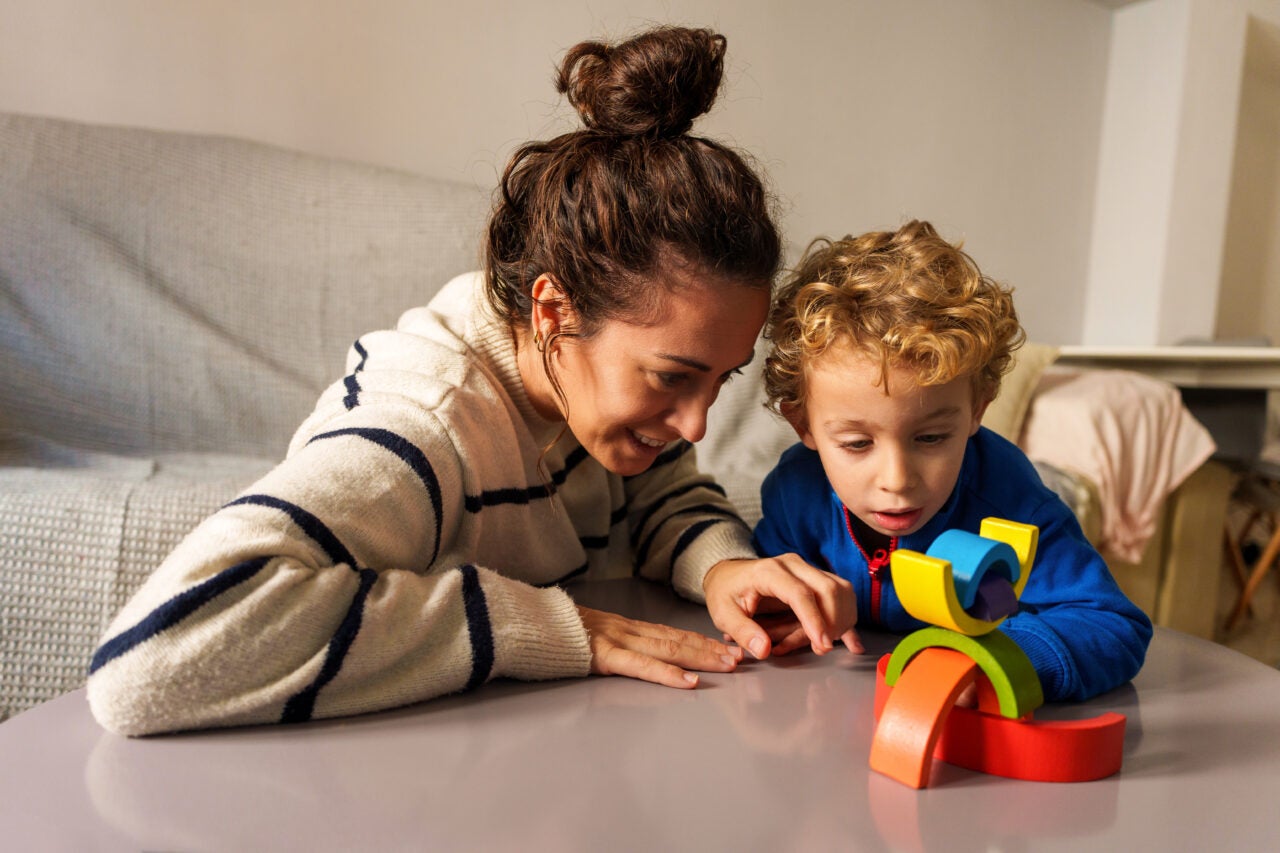
Laura recalls of her sessions, “When he was building a house with blocks, they might say, ‘Instead of saying, “Maybe we should build it like this,” let him build it. I’d let him explain it to me and feel like he was in control of the situation—and then hype him up throughout it.’”
She continues, “So I could say, ‘I really loved how you used this block to make the front door of the house, because now it can move so the little people can go inside. That was really creative of you.’ That would make him really confident, and he would want to do more, instead of saying, ‘Hey, don’t do this,’ or ‘Do it like that,’ or something that bums them out.”
When Laura joined this pilot program, her third son had already been receiving care at BMC and grief support after experiencing the loss of his baby brother from sudden infant death syndrome (SIDS) when he was 4.

“I got to see what games he wanted to play when it was just me and him, and got to see his little personality shine through and get creative. He just got more confident and happy, and that was really sweet to see,” says Laura. “Even after the program, I made sure to always put aside some time for just me and him, and me and my other boys, too.”
The value of familiarity and trust
For families affected by substance use disorder, this kind of coaching also depends on trust. BMC has built that trust through long-term relationships with families in SOFAR.
“A lot of our families have known me since their kiddos were born,” Cohan says. “Even for patients in sustained recovery, I think it’s really powerful to have a social worker that they know and trust and not have someone come in and just tell them what to do, without that foundational relationship.”
For Laura, that trust is a key part of her relationship with BMC and SOFAR.
“They’ve become like a family to us—watching my kids grow for 14 years now and everything through my recovery,” she says. “When somebody is in recovery, sometimes you can feel judged. They didn’t look at me like that. They always hyped me up and trusted me, and they always said that they have my back no matter what, that they would help me out no matter what I needed to make our family thrive.”
Outcomes from the pilot program and what’s next
The small pilot showed high engagement, with eight out of ten enrolled mothers completing the intervention. Elansary says the early signs were encouraging. In exit interviews, mothers described benefits for both themselves and their child.
With the feasibility phase complete, Elansary is now in year two of a five-year funding award from the National Institutes of Health (NIH). Year one included interviewing more mothers to assess the best ways to scale up the program for mothers in recovery. This fall, they expect to form two community advisory boards, one made up of mothers with opioid use disorder who have preschool children, and another of clinicians and staff, to help plan the next THRIVE rollout.
“When somebody is in recovery, sometimes you can feel judged. They didn’t look at me like that. They always hyped me up and trusted me, and they always said that they have my back no matter what, that they would help me out no matter what I needed to make our family thrive.”
Laura, participant in sofar’s thrive pilot program
In spring 2027, they plan to begin a pilot randomized trial with 50 mother-child pairs. Elansary says they hope to use the results to guide how THRIVE could be offered more broadly to mothers in recovery and their children.
“PCIT has such a strong evidence base, with over 30 years of randomized controlled trial evidence—but like a lot of great interventions, has not been implemented at scale or for the most underserved families. So, it’s exciting that we’re able to bring this research-backed intervention to BMC,” Elansary says.
The overarching aim is not only to boost parent-child relationships today, but to support children’s long-term health and wellbeing, including lowering their risk of substance use later in life.
“In our interviews, moms have said things like, ‘I didn’t know how to manage my feelings. Addiction was my tool. I want my kids to have other tools,’” Elansary says. “What we’re hoping is that, by providing these parenting supports and supporting caregiver emotion regulation and child emotion regulation, we’re also helping, across the lifespan, to prevent substance use disorder in the next generation.”
Learn more about Laura and her family’s journey with Boston Medical Center and SOFAR in her patient story.
About the Author

Sandra Larson
Sandra Larson is a Boston-based freelance journalist covering urban and social issues and policy. Besides HealthCity, her work has appeared in Bay State Banner, Next City, The New York Times, and The Guardian. She holds a master’s degree in Urban and Regional Policy from Northeastern University.
Share on Social

Health equity news from Boston Medical Center
HealthCity is dedicated to sharing the most cutting-edge ideas for advancing health justice through inspiring stories, in-depth Q&As with equity pioneers, research news that could change the medical landscape, and more.