A Career of Curiosity: Dr. Thea James and Three Decades of Rewriting Care at BMC
September 23, 2026
Boston Medical Center
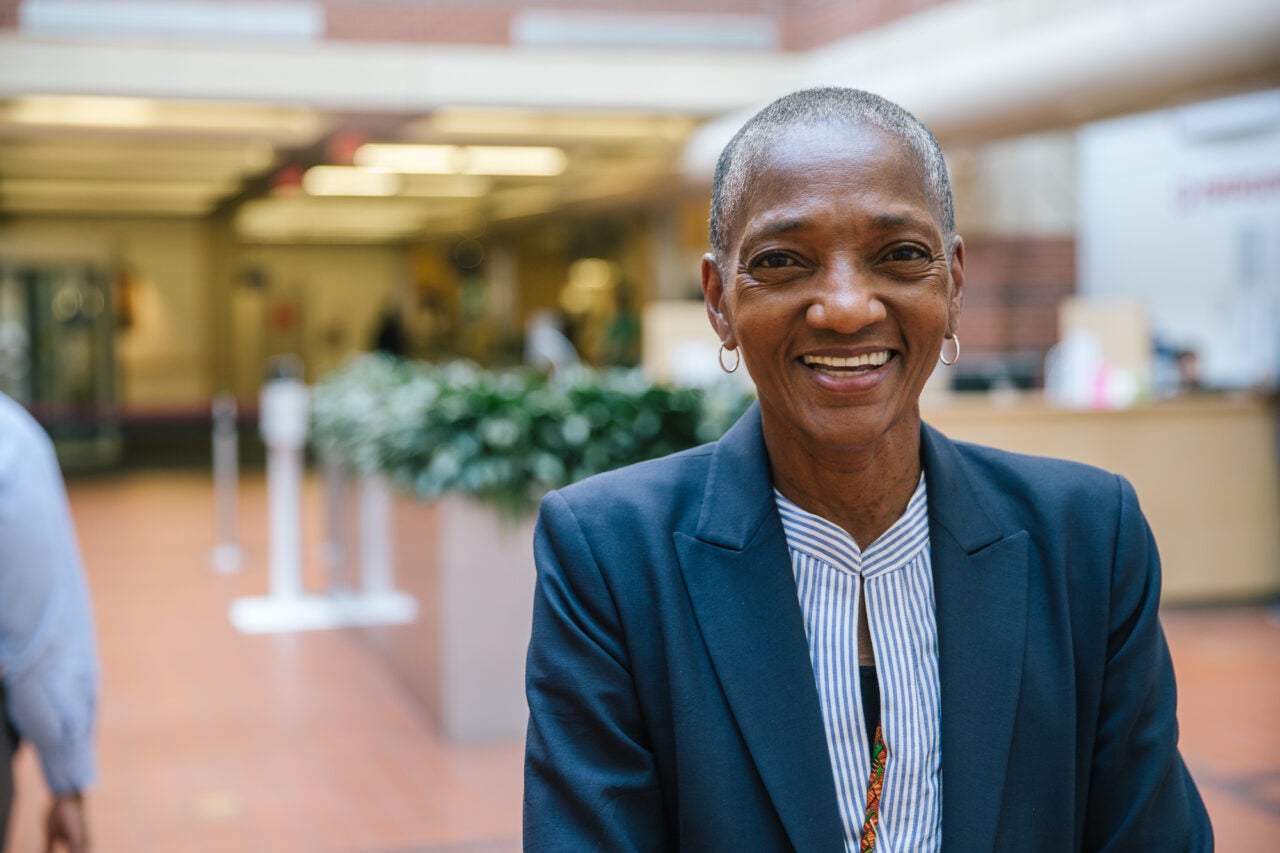
Dr. Thea James in the Emergency Department at Boston Medical Center
National health equity leader Dr. Thea James is retiring after more than 30 years at Boston Medical Center. Her career has been shaped by one instinct: listen to people, take them at their word, and refuse to accept limits in her role as a physician.
It’s the patients who still get Dr. Thea James up at 4 a.m.
“Oh my God, the patients — I love them so much,” she says. “I will miss having the chance to shift somebody’s day, their whole perspective, in a positive way. I love sitting there, talking to them, watching them, and listening to them. I think it’s such a privilege to be the person who gets to do that.”
After nearly three decades at Boston Medical Center, Dr. James, vice president of Mission, associate chief medical officer, and executive founder of the Health Equity Accelerator, is retiring.
That instinct to sit with patients, to talk to them, and, most importantly, to listen has shaped her entire career. For Dr. James, curiosity isn’t an abstract quality. It is how she moves through the world — asking questions, following the answers, and staying open to what she might learn.
“I began to notice the predictable patterns in how so many of my patients came to the ED, and rather than just accepting those patterns, I started asking patients what it would take to disrupt them,” Dr. James says. It’s a lesson she learned from her father when she was young: never to judge people because you never know their whole story.
That question—what would it take to disrupt the pattern, rather than simply treat the latest episode—became a kind of organizing principle for her career. When patients returned to the emergency department with the same problem weeks later, James wanted to understand what was happening between visits. The answers, she found, were often rooted in economics.
“Wealth is health,” James says. Access to what enables people to thrive, she argues, is at the root of many of the predictable health outcomes we see—and changing that access and economic opportunity can change a person’s life course.
Over three decades at BMC, that approach helped build national models that challenged the boundaries of traditional medicine.
Ask Dr. James about any of it, though, and she redirects the credit.
“I know how fortunate I have been to work on and alongside teams at a health system recognized nationally for its leadership and innovation,” she says. “Nothing meaningful that I have had the opportunity to be a part of was accomplished alone. Nothing.”
A diagnosis she couldn’t shake
There’s a story Dr. James still likes to tell. It’s from early in her career, when a patient changed how she understood her role as a healthcare provider.
As a young intern, she diagnosed a Haitian immigrant with HIV. He rejected the diagnosis outright: “I don’t have that. If I have it, you gave it to me.”
When Dr. James tells the story, she is quick to say that she realized the rejection wasn’t simply about the diagnosis. It was about a history she hadn’t yet learned. Haitian immigrants had been swept into the CDC’s early “high-risk” categories for HIV, a stigmatizing classification with no concrete medical basis.
“I began to notice the predictable patterns in how so many of my patients came to the ED, and rather than just accepting those patterns, I started asking patients what it would take to disrupt them.”
dr. thea james, vice president of mission, associate chief medical officer, and founding director of the health equity accelerator, boston medical center
Instead of dismissing his reaction, she looked for the gap in her own knowledge.
“The fact that he rejected the diagnosis made me realize I was missing something,” Dr. James told HealthCity in 2023. That experience led her to become the first Emergency Medicine resident at BMC to do a global rotation, in Haiti. “What I took away from that and brought back to Boston was that people interpret what they hear and see based upon lived experience,” she said.
The tattoos that inspired a national model
In the early 2000s, Dr. James noticed young patients coming into BMC’s Emergency Department with tattoos of phrases like, “Born To Be Hated, Dying To Be Loved.” At the time, and presently, the ED has been treating roughly 70% of the city’s gunshot and stabbing victims;
She started asking the young people what the words meant. Their answers revealed lives shaped by stigma, inequitable access, and disinvested communities.
“You see it faster in the ER than anywhere else,” she says, “because of how much you see every day. You ask patients why this keeps happening — and once you understand it, you have to go after it.”
In 2006, she did just that. She co-founded the Violence Intervention Advocacy Program (VIAP), part of the early seven-member network of hospital-based violence intervention programs in the country. Those programs led to and inform the Health Alliance for Violence Intervention, a national network supporting hospital-based violence intervention programs that help people affected by violence heal, recover, and connect to resources and opportunities that can prevent future violence.
VIAP was built on the idea that survivors need more than physical medical care. They need trauma-informed whole person care to heal, including mental health, mentorship, education, job training, and pathways to opportunity alongside trauma-informed care. Traditional healthcare treats their injuries. The rest helps change what comes next in their lives.

Nearly two decades later, VIAP has supported more than 7,000 patients and has become a model and partner across the country and globe.
From treating the moment to changing the trajectory
The Health Equity Accelerator may be the clearest example of Dr. James’ approach of listening and learning from patients, applied across an entire health system.
BMC had long tracked racial disparities in health outcomes and developed interventions to close the gaps. In 2021, Dr. James helped launch the Health Equity Accelerator to bring together research, clinical care, and direct input from patients and community members. The Accelerator built infrastructure to trace inequities to their root causes and address them.
“I became curious about where we, as BMC, could intervene strategically—not simply to address an immediate need, but to activate life-course transformation for our patients, their families, their communities and ultimately for our health system as well,” she says.
Maternal health offers one example. BMC researchers identified a racial gap in the amount of time women waited for urgent C-sections. The team redesigned the process around a clear target for decision-to-incision time, eliminating the gap and improving the five-minute APGAR score in the process.
Instead of asking patients to change their behavior, BMC changes the value proposition. It listens, learns, and adapts to meet needs—building care opportunities that meet their real-life needs, like remote blood pressure monitoring or other virtual care, assistance with stable housing, vouchers for transportation, access to fresh, culturally appropriate food, and more.
James is adamant that this work cannot be reduced to charity. The goal is to create durable pathways to stability, opportunity, and economic mobility, which can alter life-course trajectories for individuals, families, and communities.
“Equity and access are risk mitigators. This is a business model,” she says. “The U.S. spends more on healthcare than any country in the world, and our outcomes are the inverse. What business invests that much and expects no return? We know that positive economic transformation can improve health, create stability, and strengthen the broader economy. It isn’t complicated. We are a national model, just waiting to become a policy.”
Economic mobility and community investment as healthcare
As part of BMC’s community investment work, Dr. James, alongside other BMC leaders, helped bring Nubian Markets, a Black-owned market and halal butcher shop, to Roxbury in 2023. It was built on the belief that a neighborhood’s access to fresh, culturally relevant food, and to a thriving Black-owned business, is itself a health intervention.
For Dr. James, the work reflects a broader view of the health system as an anchor institution—an employer, purchaser, and investor as well as a place where people receive care.
With Nubian Markets, that meant recognizing that establishing a business in a disinvested community can expose owners to high interest rates and untenable repayment terms. BMC offered a zero-interest loan with more favorable repayment terms to give the business room to sustain, grow and scale.
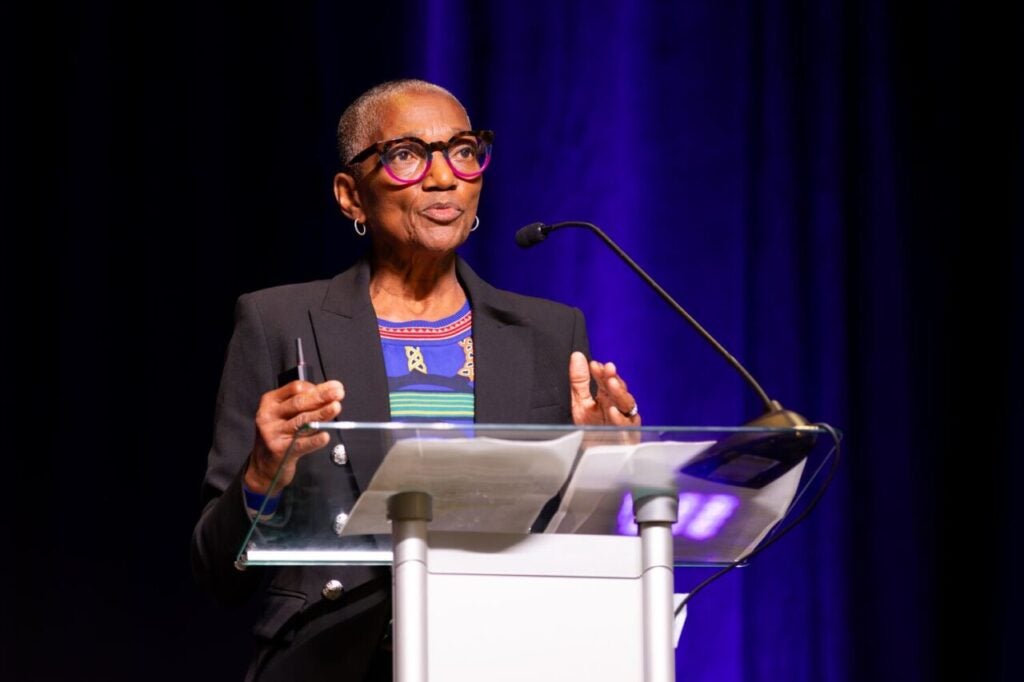
Last year in her opening remarks at BMC Health System’s EQTY conference, a racial health equity summit that Dr. James helped launch, she put it this way: “Closing racial health outcome gaps requires us to fundamentally reexamine, reimagine our role not as healers of individuals, but as architects of equitable thriving communities.”
What she actually wants remembered
Dr. James’ career has brought a long list of honors, including the NAACP’s Dr. William Montague Cobb Award, the Schwartz Center Compassionate Caregiver Award, and the American College of Emergency Physicians’ inaugural Thea James Social Emergency Medicine Lifetime Achievement Award, created in her name.
But awards were never the point. After all these years, she says, she has arrived at a certain clarity.
“I am not confused about what I have seen. Access is not complicated,” she says. “Economic mobility is what brings access to opportunity, education, employment, housing, and excellent healthcare.” In that sentence is the answer to the question that has followed James throughout her career: What would it take for this not to happen again?
The challenge, she says, is whether institutions are willing to organize themselves differently enough to make that access and economic mobility possible.
And perhaps that is the thread running through Dr. James’ three decades at BMC: She has never been interested in accepting the limits of what’s possible. She asks questions, listens to the answers, and then, more often than not, tries to do something about what she hears, at first on a personal level and then on a systemic one.
Her decision now to retire, is also an act of deep listening, and this time to herself.
“It feels right in my soul,” she says. “Curiosity has led me to every place I have landed. It led me to BMC. Now, clarity tells me what comes next.”
Join Dr. Thea James and other health equity changemakers at EQTY 2026: Forward By Design, BMC Health System’s annual conference on October 20 in Boston, Massachusetts. Register now and learn more on the official EQTY 2026 website.
About the Author
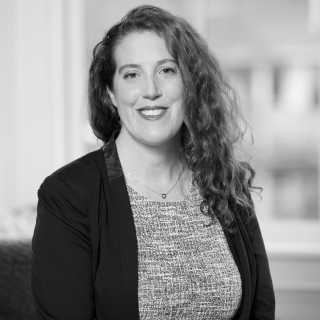
Caitlin White
Caitlin White is the Director of Content Strategy at Boston Medical Center Health System.
Share on Social

Health equity news from Boston Medical Center
HealthCity is dedicated to sharing the most cutting-edge ideas for advancing health justice through inspiring stories, in-depth Q&As with equity pioneers, research news that could change the medical landscape, and more.