BMC's New Food Box Program Is Nourishing Pediatric Families and the Local Economy
July 30, 2026
John Gillooly, Boston Medical Center
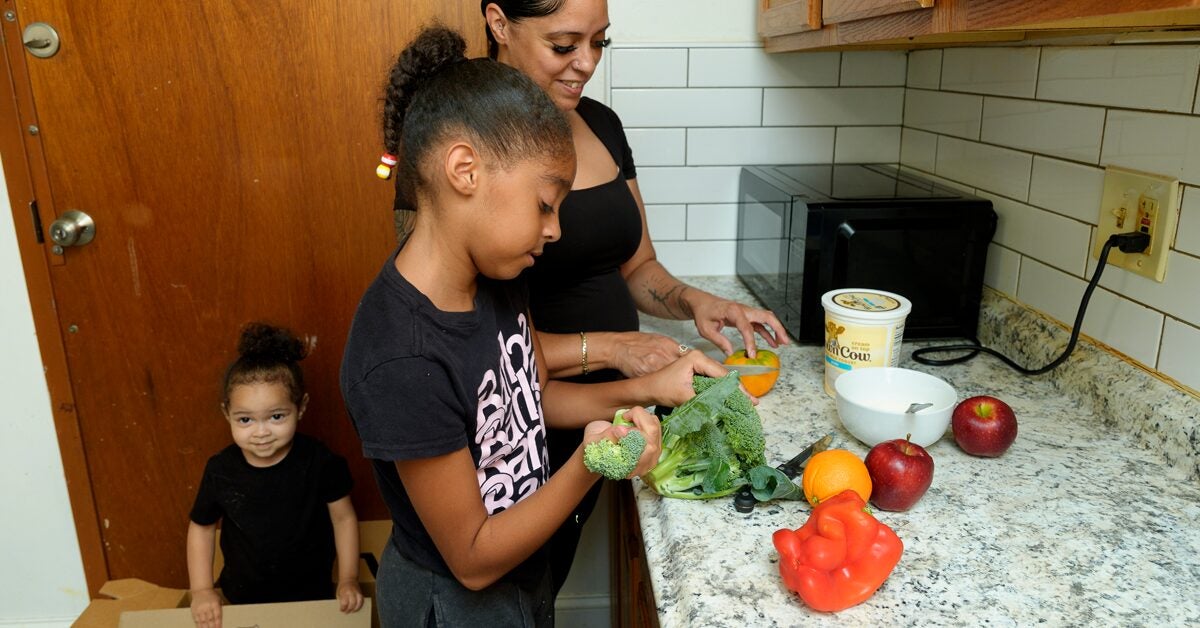
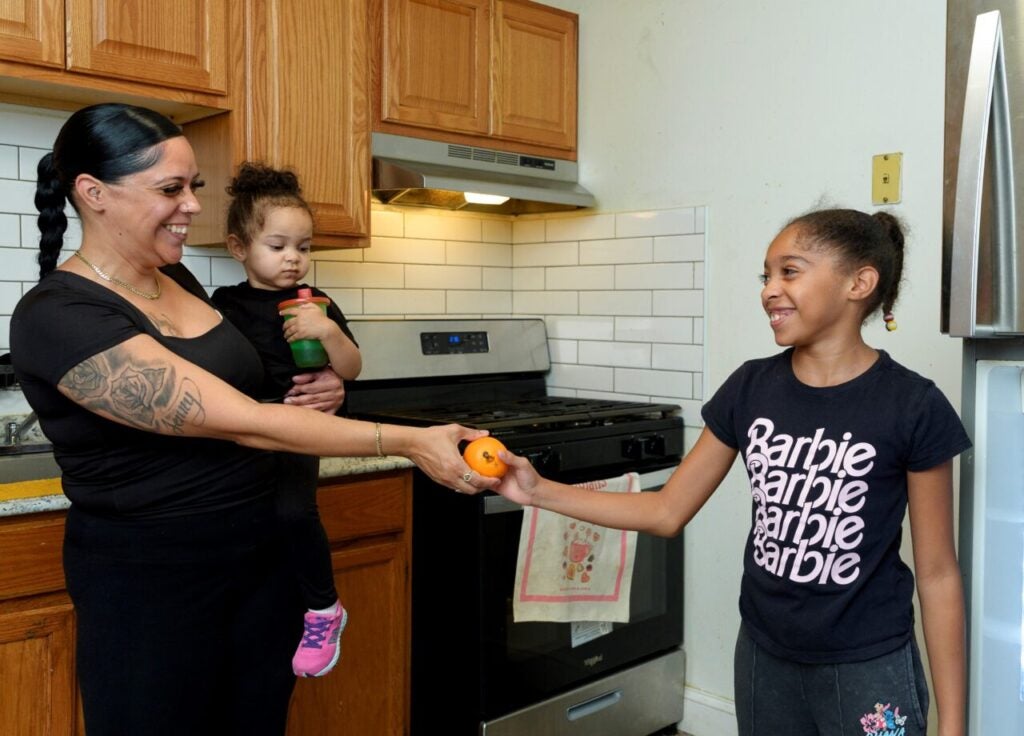
BMC's Nourish at Home: Food Boxes program addresses food insecurity and health-related needs among families with young children in BMC’s Pediatrics Department. Designed by registered dietitians and shaped by patient feedback, each box—developed in collaboration with Nubian Markets—features fresh, locally sourced ingredients. Pictured: April Martinez and her two daughters, including her youngest, a Grow Clinic patient, preparing a meal from their food box.
"Every time I open the box, I'm like, 'This is the freshest produce I've ever seen,'" says April Martinez, whose youngest daughter is a patient at Boston Medical Center’s Grow Clinic. She's one of 240 families now receiving biweekly boxes of dietitian-designed food—sourced from a Black-owned neighborhood market BMC helped launch.
With grocery prices rising 30 % over five years and still climbing, putting healthy food on the family table is increasingly difficult. For busy parents like April Martinez of Dorchester, it takes creativity: shopping carefully, stretching ingredients to cover multiple meals, and scouting out and prioritizing less expensive food stores.
This process can be time-consuming. Martinez typically has to make not only a big grocery shopping trip at the start of the month, but often two or three more trips each week to keep food on the table for herself, her husband and their three daughters, ages 14, 8 and 2. And it’s not always predictable.
“This month I’ve been going a lot because my little one is sick, and then we had a storm that hit, so we needed to stock up on water and a couple of other pantry items I didn’t have,” she says, speaking with HealthCity in December. This past winter in particular was historic in terms of snowfall; one storm was even recorded as the eighth biggest snowstorm in Boston’s history.
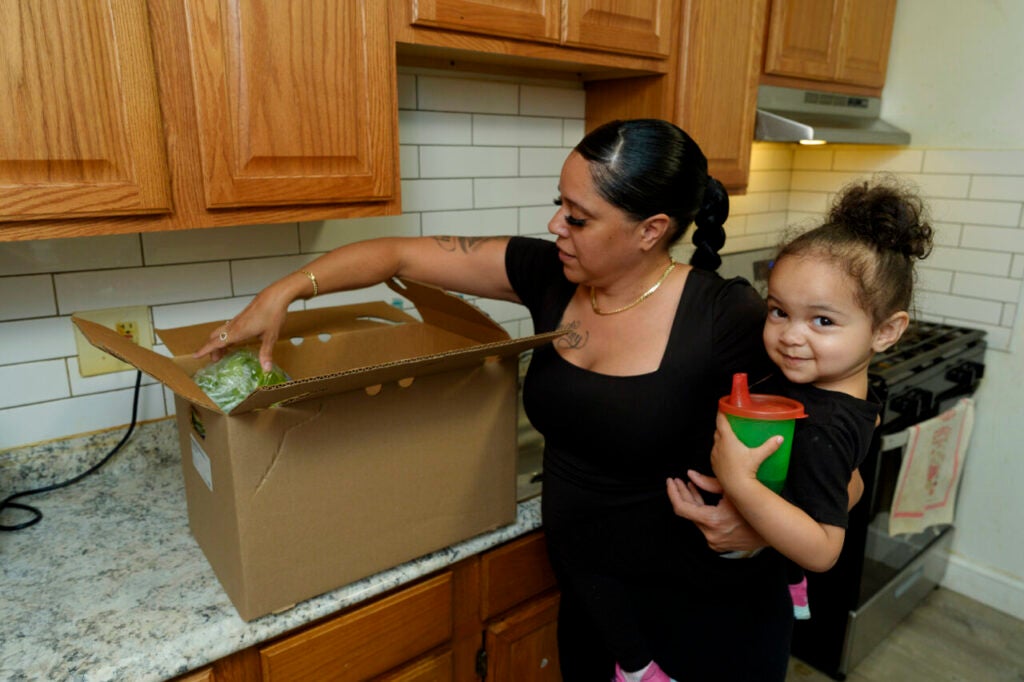
But creating nutritious and affordable meals recently became much easier for Martinez, thanks to a program at Boston Medical Center (BMC), where her youngest child is a patient in the pediatric department’s Grow Clinic. The clinic serves patients who are living with growth faltering, a condition which is characterized by weight gain that is lower than expected for their age. Since 1984, the clinic has been providing wraparound supports such as developmental and social services and dietary assistance to children from the Greater Boston area, which now includes the food boxes. Through BMC’s Nourishing at Home: Food Boxes initiative, a customized box of healthy prepared food and ingredients now arrives at Martinez’s door every other week.
“The first box that I got, I was like, ‘This is amazing.’ It’s good, and it’s the perfect size for my family. There’s no waste and there’s plenty of stuff in the box that I can use,” she says. “Throughout the week I don’t have to keep going back to the store—I have it all there.”
Serving the health of patients and the local economy
The Nourishing at Home: Food Boxes program launched in August 2025 thanks to a generous $1.5 million gift from the Wagner Foundation, a Cambridge, Massachusetts-based foundation that supports health equity and economic wellbeing worldwide. The goal is to address food insecurity and health-related nutrition needs for young pediatric patients and their families.
The meals and ingredients, tailored to each family’s dietary needs, come from Nubian Markets, a local Black-owned grocery and halal butcher shop that provides healthy, culturally diverse foods, employs a number of local residents and serves as a community social hub. The partnership is intentional; it grew out of BMC’s commitment as an anchor institution supporting local economies and a years-long relationship with Nubian Markets, including an initial investment from BMC to get the market up and running.
Partnering with Nubian Markets means the program is not only addressing BMC patients’ health-related needs, but it is also contributing to the health of the local economy, says Olivia Thomas MS, RDN, director of nutrition, innovation and implementation for the program.
“I love that we’re able to address larger systemic problems while also addressing immediate patient needs,” Thomas says. “Often, you have to choose between the two, and we’ve created something that addresses both.”
It was the unique community-based approach to food access—BMC’s decision to push beyond the traditional clinical lens to consider how the health of the local economy could play a role in the overall health of the residents—that inspired Wagner Foundation to partner on the initiative.
“Health equity and economic wellbeing are inseparable,” explains Caroline Easley, Executive Director at Wagner Foundation. “When a health system contracts with a locally owned market sourcing from regional farmers, a food box becomes more than nutrition. It becomes an investment in the neighborhood itself.”
The food boxes are delivered directly to patients’ homes through a partnership with DoorDash’s Project DASH initiative. In addition to the Wagner Foundation’s generous gift, DoorDash made a $5,000 grant and offers discounted deliveries. The delivery service works directly with patients to coordinate convenient drop-off times.
Early outcomes show patient satisfaction
The program has now served about 260 families with an average household size of four. While the food box contents are designed by dietitians, patient feedback plays an important role.
“We want to know, do people like it? Is it helpful? How can we make it better? What else could they use?” says Thomas.
In participant surveys, 91% reported satisfaction with the food box quality, and 86% said they experienced no challenges preparing the delivered food. More than two-thirds said they feel less stressed about not having enough food, and nearly all reported that the delivery aspect is “essential” or “very helpful.”
In early focus groups, participants described some of their kids’ “picky” preferences and allergies but also said the food boxes are leading them and their children to try new foods, from overnight oats to celery. They expressed enthusiasm for receiving recipes and cooking guidance.
All boxes contain an informational pamphlet that contains food preparation and storage tips to help families make the ingredients last over time. Martinez says she finds that inclusion very helpful for its tips and tricks, like how to make a plain chicken dinner more robust or “spruced up.” She also says the boxes have led her children to eat more healthy granola bars, yogurt, and fruit.
“I’m really happy with the food box. It has a bit of everything, even stuff that I didn’t use in my household or cook for my household, so they can try new things,” she says. “Every time I open the box, I’m like, ‘This is the freshest produce I’ve ever seen.’ Honestly, I look forward to the box. It’s like a present for me.”
Alongside the food boxes, the program connects patients to key hospital resources so that families can make the most out of their food boxes and sustain healthy eating. The program leverages BMC’s Teaching Kitchen, which offers interactive cooking classes in both virtual and in-person formats, so that families have access to virtual cooking classes that are centered around the ingredients in the boxes.
“I’m waiting for the next cooking class. I really want to do it,” says Martinez. “My kids like being in the kitchen. So that’s a perfect time for us all to be in the kitchen learning something.”
Participants may also receive individualized nutrition counseling with BMC’s pediatric dietitians for tailored guidance and continued support.
Clinical health outcomes are not yet available, but Thomas says other facets the team is assessing include the implementation logistics—with an eye on efficiency and long-term financial sustainability—and the program’s impact on the community.
“We also want to know, how is this helping the business model for Nubian Markets, and does it impact the economic effects within the Nubian Square area?” Thomas says.
The programming support that makes it possible
A key factor that made starting the Nourish at Home: Food Boxes program feasible was that MassHealth, the state’s Medicaid program, launched a Health Related Social Needs Services (HRSN) program in early 2025 that offers insurance reimbursement to providers of medically tailored or nutritionally appropriate home-delivered meals.
“For the first time, there was a billing pathway that allowed us to bill for some of the food assistance work that was happening,” Thomas says. “And rather than partnering with an existing program, we thought this was a great opportunity to address BMC’s bigger goal of community investment. And that prompted us to work with Nubian Markets to establish our own service.”
Expanding BMC’s commitment to community health
The Nourishing at Home: Food Boxes program adds another piece to BMC’s Nourishing Our Community effort, which recognizes the importance of access to nutritious food in achieving better health outcomes. That broader effort includes initiatives like BMC’s Preventive Food Pantry, which launched in 2001 as the first hospital-based therapeutic food pantry in the nation and has served more than 1 million people; two rooftop farms that provide fresh produce to the hospital community; and the Teaching Kitchen.
Meet the people powering Boston Medical Center’s Nourishing at Home: Food Boxes initiative, providing customized, nutritious food boxes to patients and families like the Martinez family of BMC’s Grow Clinic. Video by Felix Creative.
“Nourishing at Home is taking into account all three of those pillars and applying it in a new model,” Thomas says. “What’s really different here is the added partnership with Pediatrics. This is a clinically integrated service that relies heavily on a clinical workflow and a clinical team.”
The program ramped up quickly from an initial 33 households last August.
“The growth has been amazing to watch,” says Noelia Lugo, program manager of clinical innovation and entrepreneurship. “We started this from scratch, and being able to be part of something so impactful—delivering not only regular food boxes but also culturally appropriate foods to our patient families—is really important. And at the same time we’re helping this local market that grew up in that same community.”
“I love the program. I love the box.” Martinez says. “I love where it comes from and everything that comes in the box.”
About the Author
Sandra Larson
Sandra Larson is a Boston-based freelance journalist covering urban and social issues and policy. Besides HealthCity, her work has appeared in Bay State Banner, Next City, The New York Times, and The Guardian. She holds a master’s degree in Urban and Regional Policy from Northeastern University.
Share on Social

Health equity news from Boston Medical Center
HealthCity is dedicated to sharing the most cutting-edge ideas for advancing health justice through inspiring stories, in-depth Q&As with equity pioneers, research news that could change the medical landscape, and more.