Evan Scales, May Street
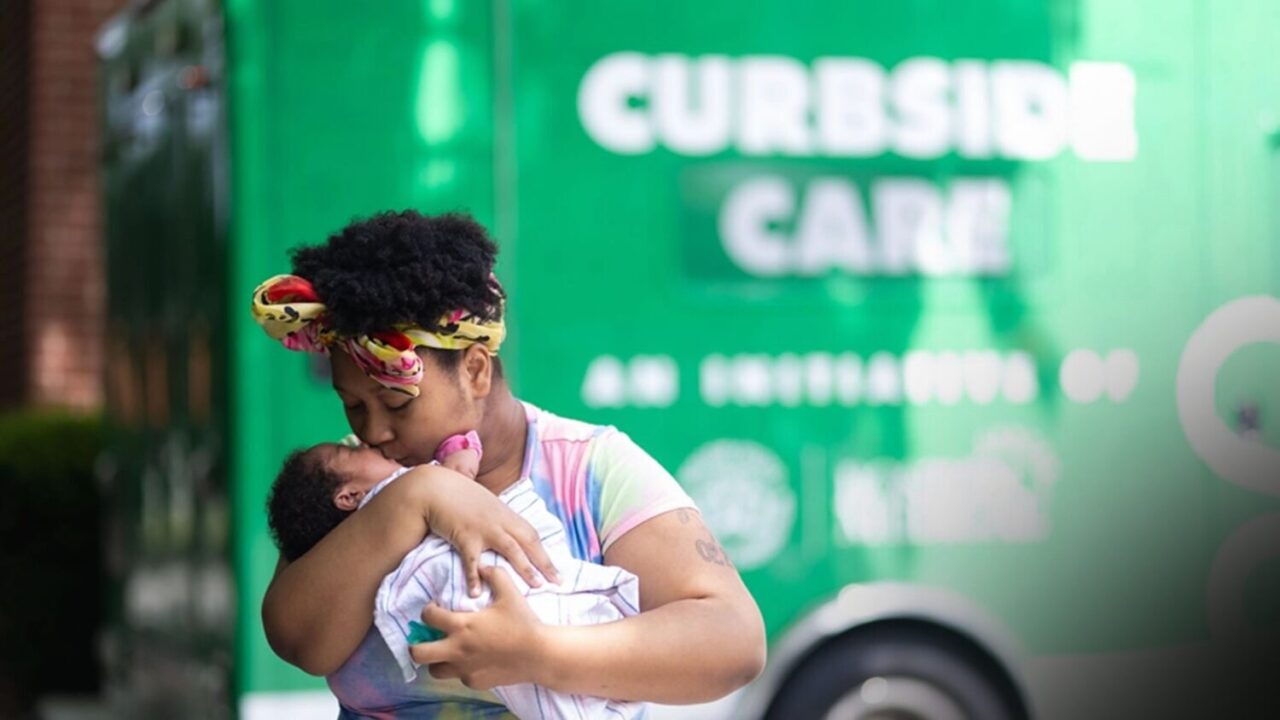
Two Curbside Care patients pose in front of the program's newly enhanced vehicle. The vehicle now has additional space and enhanced equipment, enabling the program to provide upgraded services.
At a time when new parents face mounting uncertainty, the Curbside Care Program is expanding social and community supports to reduce stress, build trust, and improve health outcomes.
The three months after childbirth, often called the “fourth trimester,” are a critical window that can define the health trajectory for mother and baby. New birthing parents must navigate the exhausting reality of newborn care while managing their own recovery. Serious health conditions such as preeclampsia and postpartum depression (PPD) can arise during this time. Yet the mothers most at-risk for these conditions often face systemic and socioeconomic barriers that can cause them to miss the postpartum appointments designed to screen for them.
“You can’t have a healthy baby without a healthy caregiver,” emphasizes Alice Cruikshank, MSN, NP, Director of Boston Medical Center’s Curbside Care Program, a unique mobile medicine initiative that cares for mother and baby together after delivery. “A mother’s postpartum depression or anxiety has a measurable impact on the baby’s development, pediatric mental health, and lifetime outcomes.”
Cruikshank leads a multidisciplinary team of providers into Boston neighborhoods to deliver postnatal care directly to patients’ doorsteps. The dyadic care model erases barriers to appointments and creates additional touchpoints for birthing parents to address their health concerns. The approach has resulted in significantly lower appointment no-show rates than BMC’s Pediatric and Obstetrics clinics.
First piloted during the COVID-19 crisis to reach families in lockdown, the Curbside Care team is recognizing the need to deepen its services amid persistent and emerging public health crises. A newly outfitted van is expanding social and community supports to reduce stress on new parents, build trust in medical systems, and improve health trajectories for families.
Steering toward family-centered care
It is hard to miss the new Kelly-green Curbside Care van driving through Dorchester, Roxbury, Mattapan, and Hyde Park. The program is generously supported by the Boston Celtics Shamrock Foundation, with funding from Tufts Health Plan. With the ongoing support of The Boston Celtics Shamrock Foundation, the team recently retired the program’s old, retrofitted ambulance to reenvision what clinical care could look like on wheels.
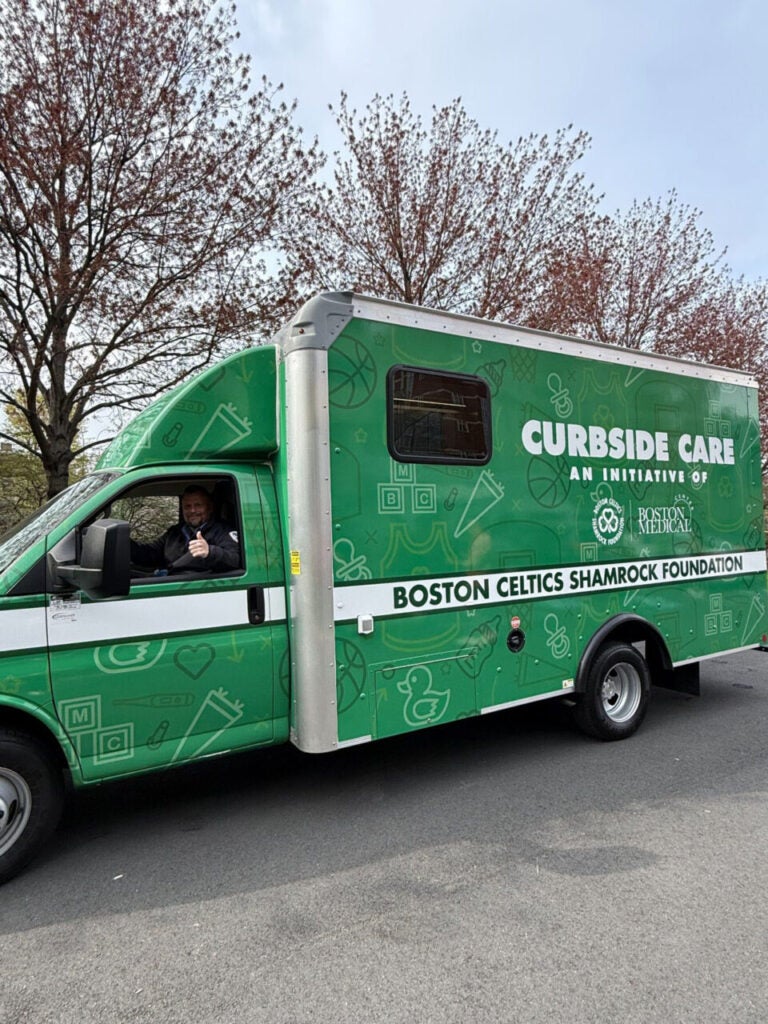
“It had to be narrow enough to navigate the streets of Boston but wide enough to welcome family support of the postpartum patient on board and to have two providers,” explains Curbside Care’s Maternal Health Lead, and nurse-midwife Rosha Forman, MSN, CNM. “We custom-designed everything from the colors of the floor and the cabinets to the specialized exam chair. The new unit absolutely has achieved our goals and is allowing us to provide seamless, comfortable care on the back of a van.”
The additional space and enhanced equipment enable the team to interview and counsel family support members, offer enhanced lactation services, and provide full OB/GYN exams in a comfortable, temperature-controlled environment.
Targeting a critical window to improve long-term health
While harkening to doctor house calls of eras past, Curbside Care is working to dismantle generational cycles of health disparities, instill trust, and place new families on a firm trajectory toward better health. The program serves a patient population—roughly 66% Black and 33% Hispanic/Latino/a—that is historically and statistically most at risk for postpartum health crises and least likely to receive specialized follow-up care. At BMC, over 24% of postpartum visits are either cancelled or the patient doesn’t show up. Transportation and childcare barriers are often cited as a barrier to visit attendance. Addressing these barriers, on Curbside Care, over 95% of parents receive at least one postpartum visit.
“You can’t have a healthy baby without a healthy caregiver. A mother’s postpartum depression or anxiety has a measurable impact on the baby’s development, pediatric mental health, and lifetime outcomes.”
Alice Cruikshank, MSN, NP, Director, Curbside Care Program
Massachusetts faces stark racial disparities in maternal morbidity that mirror national statistics. In 2024, Black women in Massachusetts were nearly 2.5 times more likely to experience severe health complications in pregnancy and birth than white women. Hypertensive disorders like preeclampsia and eclampsia are leading causes of severe maternal morbidity and mortality, with new-onset postpartum preeclampsia more frequent in Black women. Additionally, one in seven birthing people experience postpartum depression (PPD), which can seriously impair the parent-infant bond and caregiving capacity. Recent research indicates that low-income women can face a higher risk of developing PPD than their higher-income counterparts. PPD can ripple beyond the caregiver and can affect children with lasting implications throughout their lives.
Curbside Care introduces universal, evidence-based screenings for PPD and anxiety starting at two weeks postpartum. The program refers birthing parents to a suite of perinatal mental health services that have been designed and developed at BMC, including therapy and medication management. Crucially, the mobile model allows the team to seamlessly escalate care during emergencies by coordinating directly with BMC’s BEST Mobile Crisis Intervention team, who can respond immediately to a mental health crisis at home.
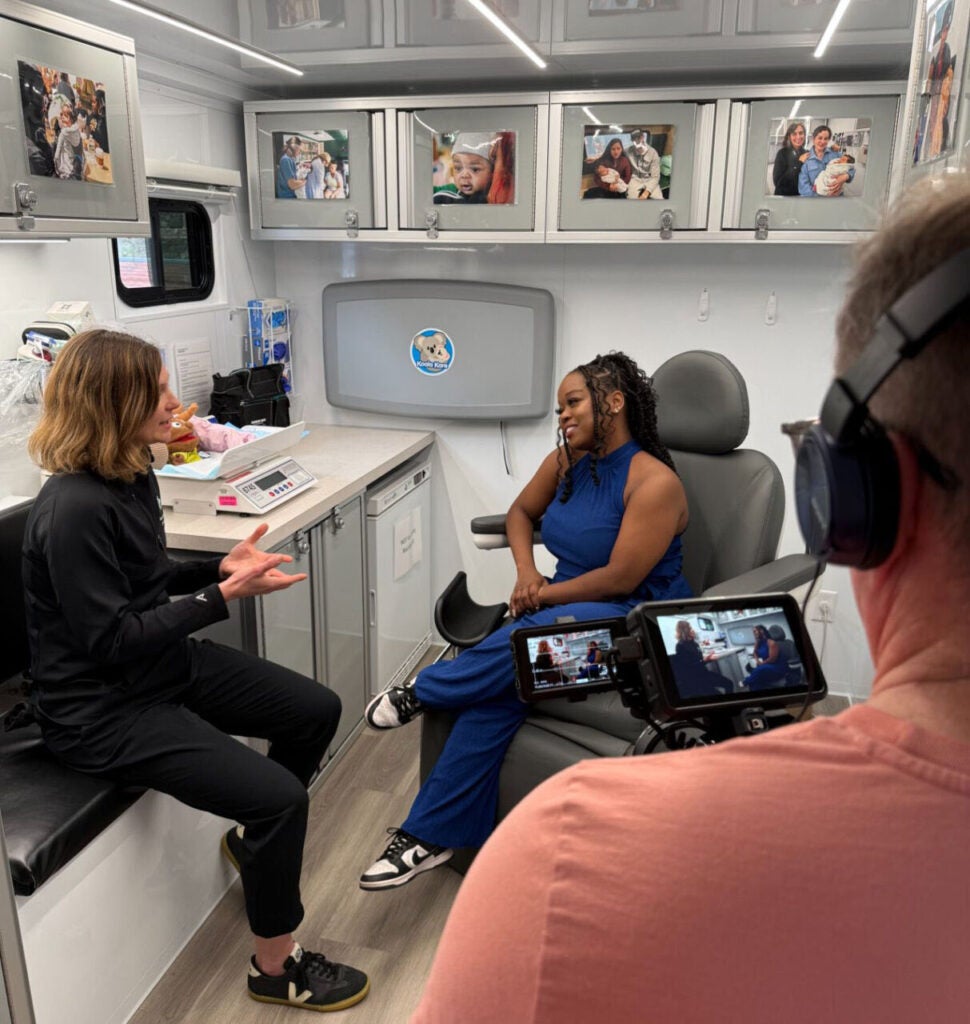
“When you have a small team and you’re coming to the patient rather than having the patient come to you, and you’re really meeting people where they are and taking the time to listen, I think people trust our team in a pretty profound way,” explains Forman. “I think we’ve been able to uncover both mental health and physical complexities that maybe would not have been diagnosed in a traditional model.”
Expanding support for the stress of the newborn period
In addition, Curbside Care aims to ameliorate stress on new parents by expanding support. In addition to addressing recovery, contraception, nutrition, sleep, and infant development at appointments, the model embeds lactation support services. Breastfeeding and infant nutrition are significant stressors for new parents. The program’s lactation consultant builds relationships with patients prenatally and rounds on the van twice a week. Patients have access to donor milk, hospital-grade breast pump rentals, and referrals to Breastfeeding Medicine for higher-level care. In 2025, 80% of Curbside Care patients were seen by a lactation consultant.
Additional wraparound support helps families build healthy foundations. A community wellness advocate is a key member of the Curbside Care team, conducting a prenatal needs assessment and connecting qualifying patients to nutrition programs like WIC and SNAP. Following delivery, the advocate rounds on the van serving as eyes on the ground to identify needs and connect patients to specialized BMC services such as StreetCred for financial coaching and Birth Sisters for additional postpartum doula support.
“I think people trust our team in a pretty profound way. I think we’ve been able to uncover both mental health and physical complexities that maybe would not have been diagnosed in a traditional model.”
Rosha Forman, MSN, CNM, nurse-midwife and maternal health lead, Curbside Care PROGRAM
“Anecdotally, you can see the difference in patients who feel supported. The support one has really impacts the postpartum experience and overall well-being. It’s really noticeable,” emphasizes Cruikshank.
Building trust on new terrain
Amid a climate marked by uncertainty and apprehension, the Curbside Care Program is forging critical connections between healthcare providers and immigrant communities. As recent reporting from The Boston Globe reveals, pregnant immigrants are stepping back from essential medical care out of fear of detention or deportation. Providers worry this erosion of trust will have far-reaching consequences on public health.
As a Curbside Care provider, Forman sees how the mobile clinic shifts the power dynamic, empowering patients to feel more in control. It is a level of autonomy she hopes her patients carry with them when they resume onsite medical care after their six-week postpartum visits are complete.
“We’re experiencing a lot of mistrust right now in the health care system. Through Curbside Care, patients see the hospital investing in their care and wellbeing by visiting them directly in their neighborhood. It’s really impactful,” she observes.
By improving access to comprehensive postnatal care and fostering community trust, Curbside Care is directly reducing the physiological and emotional stress on families most at risk for poor health outcomes. While it is still early to measure the full impact of these interventions, the program is at the forefront of a burgeoning perinatal mobile health movement and is working to spearhead national forums and share key learnings.
“We are incredibly fortunate for our funding, which enables us to explore the benefits of dyadic care. By launching monthly national meetings for perinatal mobile health programs and sharing our experience, we hope to shift that mentality toward a more holistic approach that supports the health of the mother, the baby, and ultimately the entire family,” explains Cruikshank.
About the Author

Meryl Bailey
Meryl is a freelance writer passionate about public health, social justice, and medical innovation. As part of her writing career, she worked as a communications specialist in both the healthcare and nonprofit sectors. She holds a bachelor's degree in English literature from Georgetown University.
Share on Social

Health equity news from Boston Medical Center
HealthCity is dedicated to sharing the most cutting-edge ideas for advancing health justice through inspiring stories, in-depth Q&As with equity pioneers, research news that could change the medical landscape, and more.