“It Keeps Me Up at Night”: How One BMC Psychiatrist Aims to Close the Mortality Gap for People With Psychosis
July 24, 2026
By Gina Mantica
Michael Mancuso Creative
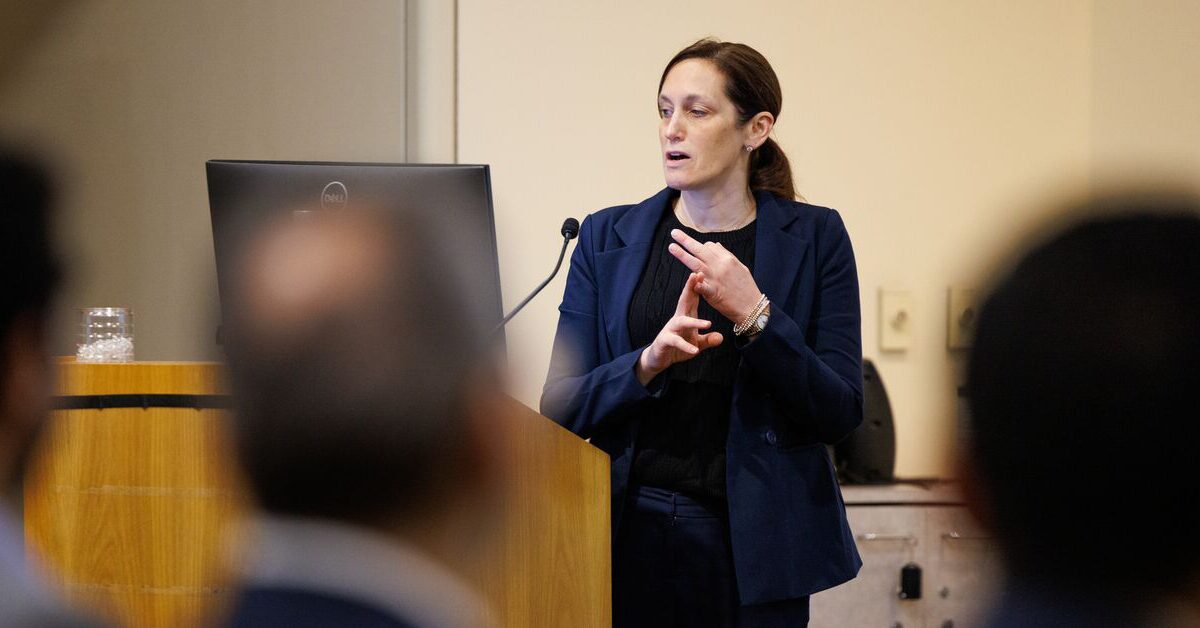
Hannah Brown, MD, director of Boston Medical Center’s Wellness Recovery After Psychosis (WRAP) program, delivered the keynote address at BMC Brighton’s annual Research Day. Her address highlighted her research on integrating psychiatry and family medicine to redefine outpatient care. (May 28, 2026).
Schizophrenia affects 23 million people worldwide, and the leading causes of early death aren't psychiatric — they're metabolic, cardiovascular, and systemic. Dr. Hannah Brown is building a new model of care at BMC to address all of it.
Schizophrenia affects 23 million people worldwide, according to the World Health Organization, and its impact stretches far beyond prevalence alone. Schizophrenia carries a mortality rate nearly two to three times higher than that of the general population and people living with schizophrenia die, on average, 15 to 20 years earlier than their peers — a mortality gap driven not primarily by the illness itself, but by a compounding set of related factors: higher rates of smoking, cardiovascular disease, diabetes, healthcare disparities, and the metabolic side effects of the very antipsychotic medications used to treat the condition. Despite advances in psychiatric research, this mortality disparity has persisted for decades, and recent data suggest it is not narrowing.
Hannah Brown, MD thinks about this gap every day. As director of the Wellness and Recovery After Psychosis (WRAP) and vice chair of research in psychiatry at Boston Medical Center (BMC), Dr. Brown has built her career around understanding and dismantling the barriers that prevent people with serious mental illness from living full and healthy lives.
In this Q&A with HealthCity, she shares what drew her to psychiatry research, how she aims to help her patients, and where she sees the most promising paths forward.
HealthCity: What is the broader goal of your psychiatry research?
Hannah Brown, MD: One thing that keeps me up at night when I think about my patients is the mortality gap. We have a special clinic at WRAP for younger people coming in with a new diagnosis of psychosis. These people are at the very beginning of their illness journey and, according to the data, they are likely to die 20 years earlier than their counterparts in the general population. And the gap is actually growing. In the general population, people are living longer and healthier lives, but we are not narrowing the disparity for people with serious mental illness. Understanding why, and figuring out what we can do about it, is at the core of my research. This critical work is made possible in part by generous support from the Jack Satter Foundation and Jason and Jamie Brown.
Part of that gap comes from higher rates of smoking, part from the cardiovascular and metabolic risks associated with antipsychotic medications, and part from the broader social determinants of health that our patients face. So, we are working on several fronts.
We’ve partnered with our Teaching Kitchen, made possible by funding from the Sydney R. Baer Jr. Foundation, to help individuals with psychosis learn about healthy eating, how to make nutritious food accessible and affordable, and how to work with the ingredients they have. That kind of practical skill-building can make a real difference in people’s long-term health.
Another area I’m really excited about is the use of GLP-1 receptor agonists in serious mental illness. These medications could have a significant impact on decreasing the mortality gap for people with psychosis by preventing the long-term metabolic side effects that come with antipsychotic medications or addressing lifestyle-related risk factors before they become crises. And there’s a psychological benefit there, too — if people are feeling physically healthier and less burdened by side effects, that matters enormously to their overall wellbeing. If we can predict who would benefit most and start them early, that is a really exciting research direction we are moving into.
We’re also trialing a newly FDA-approved medication treatment that is supposed to have fewer side effects and conducting a qualitative study to understand whether it is acceptable to patients.
Another thing that keeps me up at night is how to help people who drop out of care. Early in the course of a psychotic illness, staying in treatment is critical. We know that outcomes are significantly better for people who remain engaged versus those who have breaks in care. That is why we’ve developed a community-based care model that meets patients where they’re at. We have a new community health worker working specifically with young individuals in Boston who have disengaged from care, trying to understand the barriers and figure out how to reengage them. It’s about building trust and making sure people know that connection and support are always there for them.
HC: What first inspired you to pursue psychiatry research?
HB: I was always interested in the brain and how it worked. My dad is a neurologist, so the brain was part of my environment growing up. Before medical school, I worked in a neurobiology lab studying the olfactory system, which is the sensory system responsible for the sense of smell, and I loved it. But I wanted to think about pathophysiology in a way that I could apply to patient care, to take what people study in the lab and actually use it to help people.
I was also fascinated by how neurons communicate with each other and how systems and connections in the brain come together to let somebody understand and appreciate the world around them. When I first started working with individuals with schizophrenia, this whole world kind of opened up for me. I began to understand that their perception of reality was so different from mine, yet it was entirely internal. Two people could be standing right next to each other, and what they were experiencing could be completely different. That was both profound and humbling to me to ask, what is going awry in the neural systems and connections that create such different perceptions?
“I want WRAP to feel like a home base for our patients — a trusted space where they can receive care regardless of where they are in their illness trajectory or how heavy their symptom burden is at any given moment. Our team works really hard to create an environment where people feel safe, respected, and genuinely cared for.”
Hannah Brown, MD, director of the Wellness and Recovery After Psychosis (WRAP) and vice chair of research in psychiatry at Boston Medical Center (BMC)
The other thing that really moved me was seeing how much suffering psychosis can cause and also recognizing how much recovery is possible. If people’s symptoms are identified early and treated, they really can recover. They can do things like go back to work or school and have meaningful relationships. There is such profound stigma around people with psychosis and schizophrenia that many people never get the care they deserve, and I wanted to be part of changing that.
HC: How do you hope your psychiatry research impacts patients and families?
HB: I want WRAP to feel like a home base for our patients — a trusted space where they can receive care regardless of where they are in their illness trajectory or how heavy their symptom burden is at any given moment. Our team works really hard to create an environment where people feel safe, respected, and genuinely cared for.
What recovery looks like is different for everyone. For some of our patients, it’s graduating from college. For others, it’s living independently or simply having a meaningful daily routine. When I see people meeting their own milestones and reaching the goals they set for themselves, that is such a powerful marker that the illness is being treated.
I always tell my patients that they’ll see me fairly frequently at the beginning of treatment, when things are hard, and then less as we make progress together. And if something happens, they can always come back, talk openly, and we can think about increasing the level of treatment. That continuity and trust is at the heart of what we’re trying to build at WRAP.
This interview has been edited and condensed for length and clarity.
About the Author

Gina Mantica
Gina Mantica is the Senior Research Communications Manager at BMC.
Share on Social

Health equity news from Boston Medical Center
HealthCity is dedicated to sharing the most cutting-edge ideas for advancing health justice through inspiring stories, in-depth Q&As with equity pioneers, research news that could change the medical landscape, and more.