BMC Health System Hosted a "Family Meeting" of Experts on Land and Generational Wealth at Historic Union Chapel
August 28, 2026
Boston Medical Center
At historic Union Chapel on Martha’s Vineyard, BMC Health System brought Black leaders together to explore land, legacy, family, and generational wealth.
What do we want to pass on—and what will we build from what we’ve inherited? At a BMC Health System gathering on Martha’s Vineyard, Black leaders explored land, wealth, family history, and the choices that shape generations to come.
Brea Baker’s father cried when he read his mother’s will. His name was not in it.
To him, it meant she had left him nothing. To Baker—a journalist, a sixth-generation Black landowner, and the author of Rooted: The American Legacy of Land Theft and the Modern Movement for Black Land Ownership—it meant her grandmother had made a deliberate business decision to protect the family’s land for the generations ahead, by leaving it to one sibling in trust rather than naming all her children. Naming each child would have split the ownership into fractional shares with no clear title—a legal tangle, known as heirs’ property, that leaves land dangerously exposed to forced sale.
“She left you the gift of the business mind,” Baker recalls telling her father. “But you’re reading this will as a son who wanted your mom to affirm you. That is not an affirmation. It is a legal document.”
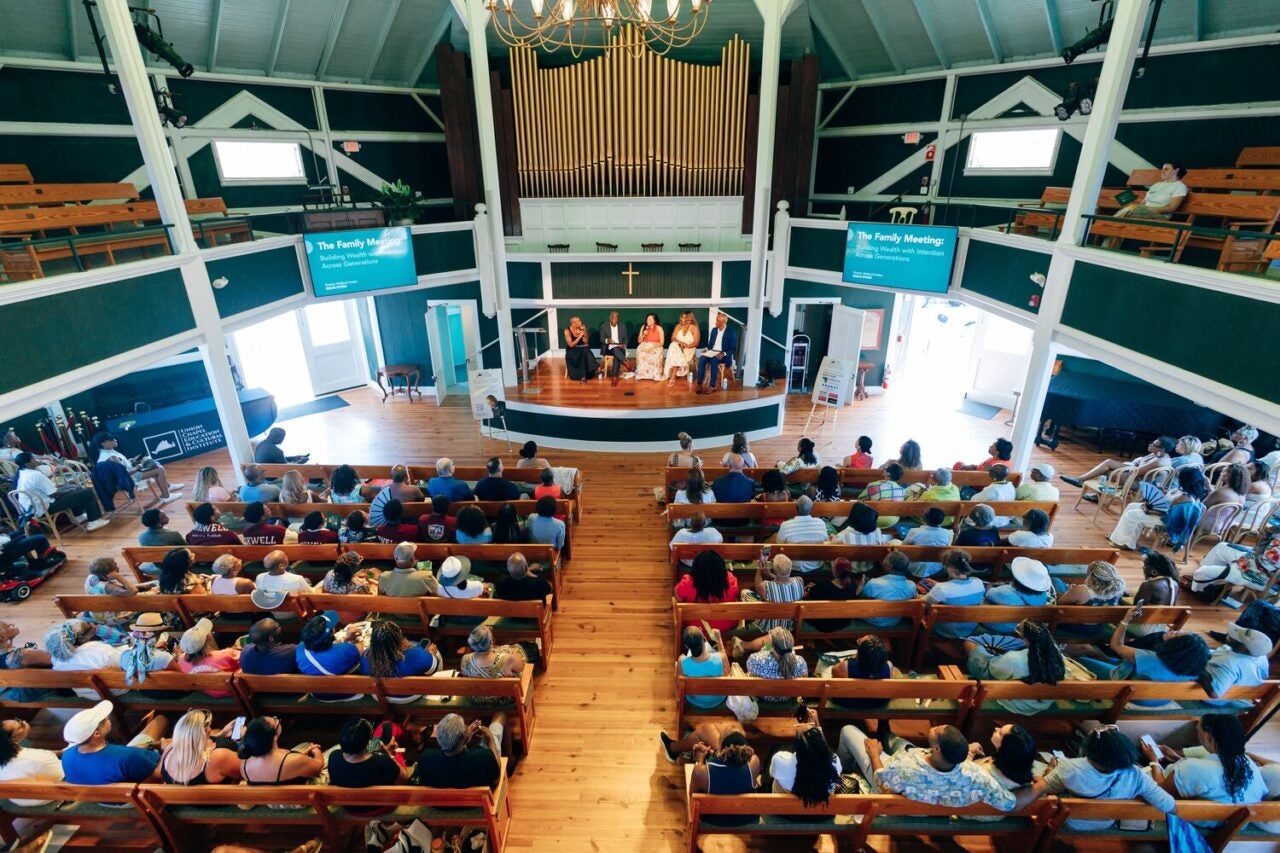
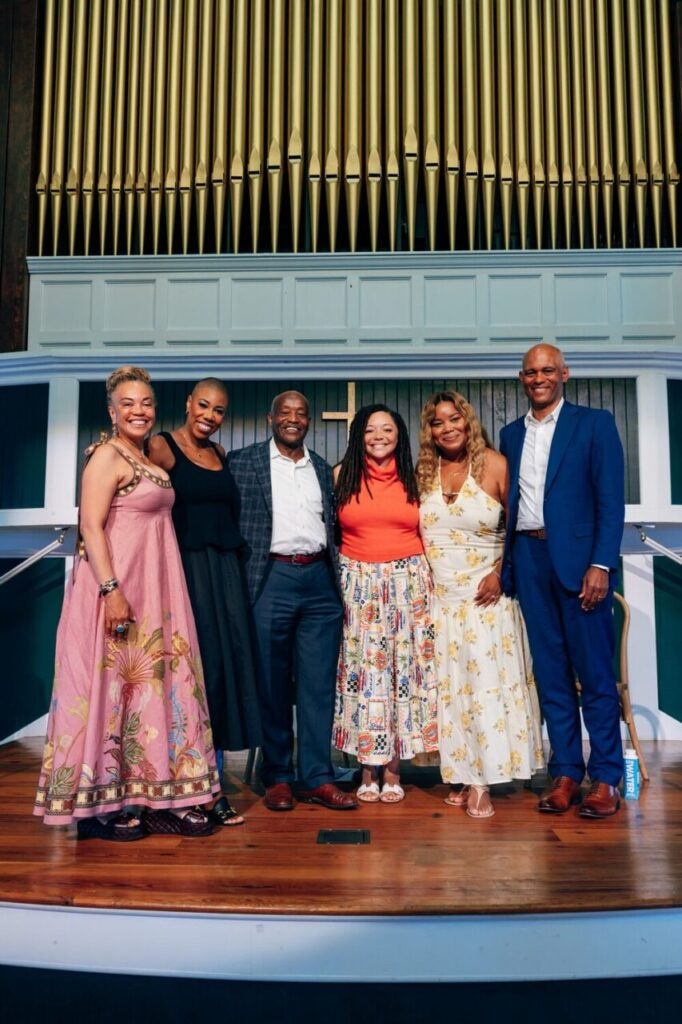
That tension was the premise of “The Family Meeting: Building Wealth With Intention Across Generations,” a panel convened by Boston Medical Center Health System on August 12 at Union Chapel on Martha’s Vineyard, hosted by Petrina Martin Cherry, vice president of community engagement and external affairs, and presented with MassMutual.
Why this conversation belongs at Martha’s Vineyard’s Historic Union Chapel
There is a reason this panel happened at Union Chapel. The land around it carries that history: Oak Bluffs became one of the few places on the East Coast where Black families could freely buy property and gather, and many did, arriving as housekeepers, whalers, and indentured servants and staying on to build lives. Charles Shearer, born into slavery, purchased a cottage that became the island’s first Black-owned guest house.
That land is what filled the chapel’s pews with the conversations of a movement. Union Chapel has long been the place where civil rights history came to rest — where the lawyers and students who desegregated Southern universities, the writers who chronicled Black life, and the leaders of the movement itself gathered summer after summer to celebrate, speak, and be honored among neighbors.
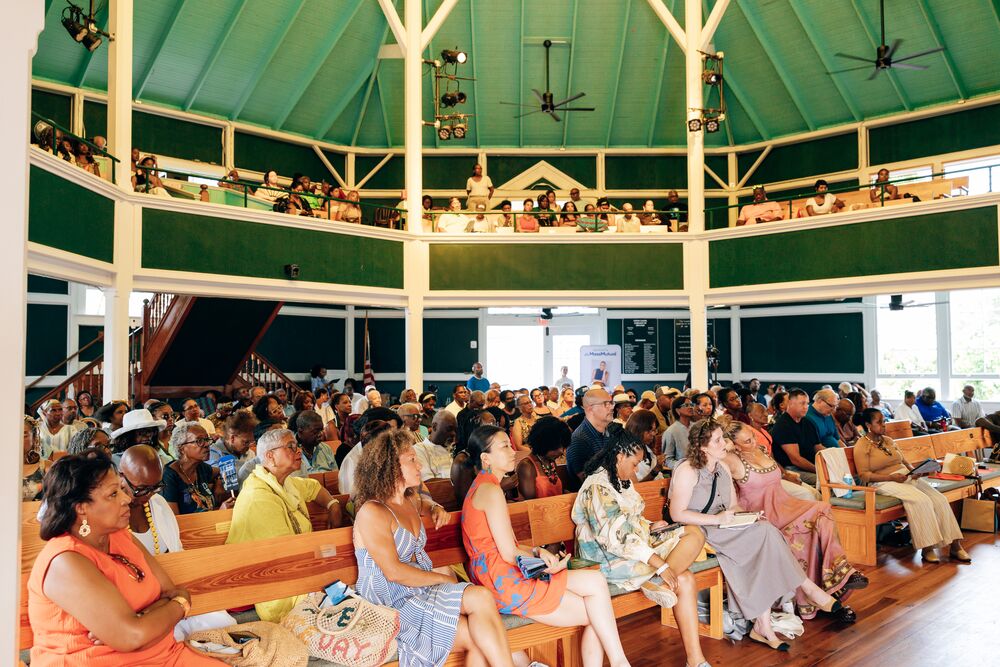
Thomas Mitchell, the Robert F. Drinan, S.J. Endowed Chair at Boston College Law School and director of the Initiative on Land, Housing & Property Rights, echoed the connection.
“Some of the most important organizing meetings happened on Black-owned farms in the South,” he said, “because people had rights to that land and they were able to hire security.” What those landowners built did not just benefit themselves. Just like the conversations in Union Chapel, it had a wider benefit, for the community and the country.
The numbers behind the conversation
Symone Sanders-Townsend, the political strategist and media host who moderated the panel discussion, opened with figures from the Massachusetts Economic Conditions and Household Opportunity Survey, released that day by the Federal Reserve Bank of Boston: the median net wealth of a white family in Massachusetts is about $549,200. For a Black family, $7,800. For a Latino family, $1,200.
Mitchell and a research group estimated the generational wealth lost through land between 1920 and 1997 at $326 billion.
“The USDA for decades systematically discriminated against Black farmers, one decade after another after another, which drove many of these Black farmers into foreclosure,” Mitchell said. “Not giving loans that the Black farmers were totally qualified for, only giving the loans at the end of planting season. One thing after another that was specifically designed to cripple these farmers.”
And he offered a statistic that felt the most actionable to the families in the audience: among Black Americans with a college degree—the group with the highest rate of estate planning in the Black community—only 32% had a will or estate plan. Among white Americans, the lowest estate-planning rate was for adults without a high school degree, and even that group sat at 57%. The gap is not about education. It is about access and trust.
The family meeting that almost did not happen
“Black families are not uniquely bad at the business of land ownership,” Baker said. “Black families are preyed upon uniquely and disproportionately, specifically when we are grieving.”
Mitchell described the mechanism: a law called the law of partition, “used by real estate speculators and others for decades to basically legally steal Black property for pennies on the dollar.”
“We can’t be too prideful,” said Simone Ashley Tyler, senior vice president of AfroTech & HealthStack at Blavity. “Sometimes, especially as a first generation or maybe second generation with access to money and finances, we don’t want to go and say I need help figuring out how to navigate this.”
“The quickest way to lose wealth is fighting with your family.”
Wilbur Peer, executive director of the KKAC Organization
Wilbur Peer, executive director of the KKAC Organization, works with Black landowners and potential landowners in the Arkansas Delta, helping them navigate these exact issues. When families call his office, the first question his team asks is whether they have an estate plan. If the answer is no, they hand them what he calls the “land Bible.”
The danger, he told the room, is not only the speculators and the partition laws. It is the family itself.
“The quickest way to lose wealth is fighting with your family,” he said. It landed. The room went abuzz. Everyone in it knew a family that had torn itself apart over land, or a house, or a will read the wrong way.
Mitchell has spent 30 years reforming the laws that make that vulnerability legal. He drafted the Uniform Partition of Heirs’ Property Act, now enacted in 27 states, which adds due process and a family buyout right before land can be forced to sale. But the law cannot make you sit down with your brother and your mother, for example, to have that family meeting.
What land can do for finances and wellbeing
While the conversation did focus on what families stand to lose, it also let audience members know what you can do when you keep it.
Baker called land “a beautiful blank canvas” and mentioned solar panels, timber, tiny homes, ecotourism, vineyards, and more. Peer pointed to the USDA’s Wetland Reserve Easement Program, which pays landowners near fair market value while they keep the title ownership.
Tyler herself had big dreams. She bought a property with 15 villas in Costa Rica and started renting it to wellness practitioners who brought Black people from the U.S. to relax, recharge, and also witness the value of land.
“The ability to walk outside of your space and pick fresh food that you grew,” she said, “it changes your thought process around your health and what you put into your body.”
Tyler is paying forward the value the land has given her—the recovery, the connection, the literal fruits of her labor, and the space to breathe.
The stories behind the land
The storytelling and knowing your family history, Baker said, is where all of this should start. Baker traced her family’s land to her great-great-great-grandfather, Louis Baker, born enslaved, who bought land in North Carolina in the 1880s.
“There’s no way that Louis Baker is going to buy this land when he was born enslaved and my free generation is going to be the one to lose it. “I think it’s so important to know how hard fought for it was,” she added.
“We do that really well when it comes to the recipes and the cooking but there are other recipes you need to pass on that are not literal in the kitchen that we need,” she added.
Tyler found the same truth from a different direction. When she first visited Costa Rica it was because of a health crisis—a burnout so severe it manifested in her body. Then she learned that the descendants of landowners in Costa Rica’s Limón province were mostly Jamaican and Panamanian. She did her ancestry research and found relatives living there—families connected to hers across generations of migration. The land she bought was land where people of her background had been living for generations.
“I actually do have connections,” she said.
What comes next?
The panel ended with a question: if everyone in the room went home and called their family meeting, what should be the first item on the table? Peer said to start by identifying the land’s last known owner and building a family tree. Baker said to find the family historian before it’s too late. Tyler said to ask about everyone’s health first, since a health crisis is often what drains a family financially. Mitchell pointed to organizations doing family mediation.
None of them said wait. Union Chapel has hosted these conversations for more than 150 years — not to mourn what was lost, but to decide what comes next. The hope is that every family in that room goes home and holds their own: on their own land, at their own table, while there is still time.
About the Author
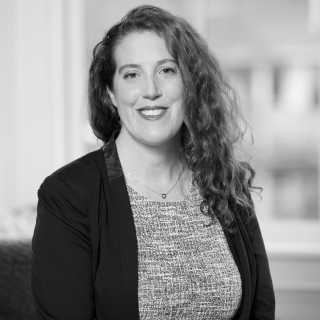
Caitlin White
Caitlin White is the Director of Content Strategy at Boston Medical Center Health System.
Share on Social

Health equity news from Boston Medical Center
HealthCity is dedicated to sharing the most cutting-edge ideas for advancing health justice through inspiring stories, in-depth Q&As with equity pioneers, research news that could change the medical landscape, and more.